Run the equator: Laos
Showing posts with label Laos. Show all posts

Thursday, April 17, 2008

The longest boat ride

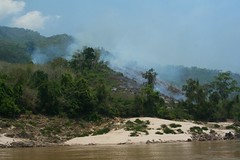
Burning land
Click photo to see slideshow
or here for all Mekong trip photos

The major attractions of the Laos tourist track are strung like beads on a rope along Route 13, which spans the whole length of the north-south axis of this country shaped somewhat like a deformed cooking pan or a spiked battle axe. Once you’ve seen the south and followed the Mekong northwards through the “panhandle” to Vientiane, once you’re done with tubing and partying in Vang Vieng and got your share of temple photos in Luang Prabang, you have a choice: you can either continue the arduous land journey north, to the remote highlands in the Phongsali province, or you can return to Thailand - which is what most tourists do. It wouldn’t be much fun to backtrack your steps all the way to Vientiane in order to cross the border; no traveler likes seeing the same roads again on their way home. Fortunately, there’s a better alternative: the Mekong.
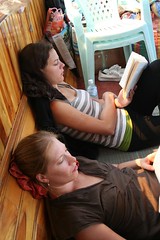
A cozy spot

From Luang Prabang to Huay Xai on the Thai border, the river journey takes two days by slow-boat. These are long, low-floating, single-deck covered boats capable of transporting a few dozen passengers. Called slow-boats for the obvious reason that there are also fast boats on the same route, most tourist prefer them to the faster alternative for reasons related to comfort and safety - the fast boats are minuscule, ultra-light contraptions that can only seat a few cramped passengers and move at break-neck speed; they have been known to flip over occasionally, with deadly consequences. The level of comfort on the slow boat varies with the number of people and the quality of the seats. Most boats have a few rows of reclining seats that look like they have just been ripped out of a minibus – in fact they are just that: minibus seats whose metal railings have been mounted on pieces of wood so they won’t damage the lacquered wooden floor planks. In addition to those, the boats hold a number of movable small wooden benches who look - and are - very uncomfortable; in the long run, the coziest spot for resting may end up being the floor. There is a bathroom on board and drinks are can be purchased. You can walk around, stretch your legs or lie down if you chose, and with the right company, be that people you like or a good book, you can spend the time pleasantly. And time you have, if nothing else; each day, for 10 hours, the boat munches its way against the current through the never-ending jungle-covered hills, through swats of land fallen victim to the yearly slash-and-burn agricultural ritual, through mountains of layered sediment brought downstream by past floods and millions of monsoon seasons.
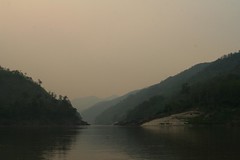
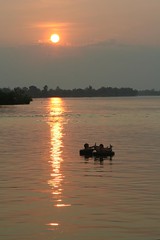
Sunset on the river

There is a travel agency in every house on the main street in Luang Prabang; all of them sell tickets for the slow boat - at a charge. They seem to be doing a good business of it - few tourists bother going down to the slow-boat landing to check the prices at the ticket office. The fare to Pak Beng - a riverside village where you must spend the first night, half-way between Luang Prabang and the Thai border - is 110,000 kip for foreigners (about $12.50), but the more brazen agencies will slap an extra 30,000 kip ($3.50) on your back – one of those rackets is right near the ticket booth! In Pak Beng the ticket for the second leg of the trip costs 115,000 for foreigners, but if you fall for the tricks of the few Luang Prabang agencies who sell the ticket all the way to the border, you’ll pay a lot more. As usual, it’s worth checking prices in advance - buy the ticket at the pier or negotiate with the travel agencies. Sadly, the complacent attitude of many tourists, “oh, it’s only three more dollars, never mind,” works against everybody’s interest giving a blank check to businesses’ greed. It only helps drive prices higher for both locals and tourists.

  “How many hours to Pak Beng?” I ask the lady behind the desk at the travel agency.
  “6 or 7. Boat leaves at 8:30 in the morning.”
  “On the second day, are we going to arrive at the border before it closes?” I wanted to know if we had to spend two more nights in Laos or just one.
  “Yes.” I realize I just asked a question leading to the answer that I wanted to hear, so I rephrase:
  “What time do we arrive at the border on the second day?”
  “At three o’clock,” she assures me. The border closes at 6PM, so we may make it to the Thai side the same day. Three different agencies give me similar answers.
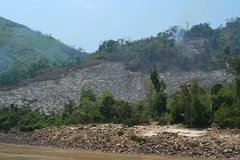
Slash and burn

But we didn’t make it in time. The first day of traveling, we took 9 hours to Pak Beng. The second day we spent 10 hours afloat and we arrived in Huay Xai after dark. What is this worldwide tendency of travel agents to lie to their customers about arrival times? They know how long the trip really takes, don’t they?! We would have taken the boat anyway, even if they had told us the truth... Spending a last night in Laos wasn’t bad at all. I enjoyed the last few Beerlao (one of my favorite lagers on this trip) with Craig, Rae and Jordan, some Aussies we had met on the boat, and spent our last kip which were going to become useless once we arrived in Thailand – you can pay for almost everything in Thai baht on the Lao side of the border but you cannot use kip anywhere else.

And so the next day we crossed the river into Thailand and took a minibus to Chiang Mai. We had reached the last destination of our year-long journey.

Posted from Hat Sai Khao beach, Ko Chang island, Thailand.

Click here to read more...

Sunday, April 13, 2008

Luang Prabang, a Kingdom afar

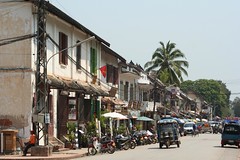
Luang Prabang is ready for business!
Click photo to see slideshow
or here for all Luang Prabang photos

Laos is a communist state, and therefore the official propaganda is still reviling all the social evils that the Pathet Lao party has triumphed upon with its seizure of power in 1975: capitalism, imperialism, and monarchy. But the voices of the official party line are more likely to be muffled these days; the tune is a different one, in sync with the political realities of China and other nominally-communist states that have abandoned the economic doctrine of collectivization: “get rich if you can, but do not dare defy the party”. And the Lao are very busy trying to make money; every day of the week is business as usual in Luang Prabang for night market sellers, for tuk-tuk drivers, for tourism agencies, restaurants and guesthouses.

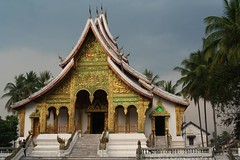
Dark clouds over the Royal Palace wat

Even the tough stance on monarchy - a staple of propaganda literature of all communist regimes - has softened in recent times: there are amulets for sale at the market with carvings and pictures of the late kings of Laos, and the neatly preserved Royal Palace Museum in Luang Prabang is the main tourist attraction in town. It’s a rather austere royal residence, more of a large country mansion than a sumptuous palace. As a museum, it provides a good insight in the simple lives of the royal family of a poor, mountainous kingdom, squeezed between more powerful neighbors. In the room reserved for diplomatic gifts to Laos from other states, there’s a noteworthy token of appreciation sent by US President Nixon (hence still addressed to the Royal government, since Nixon’s presidency ended before the communists took power): a scale model of the Apollo 11 lunar module and some tiny bits of lunar rock cast in a glass bubble supported by a plaque which bears a miniature flag of the Kingdom of Laos and an inscription in English saying that the flag has been flown to the moon and back. A strange and cynical gift to the people of Laos, considering that at the time the United States was busy bombing their country to bits.

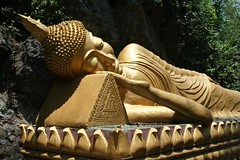
Reclining Buddha on Phu Si hill

Stay another day!” – the words of this unofficial tourist mantra of Luang Prabang lure you from street banners, advertising windows and tourist brochures all over town. We stayed four days, defying the crushing heat, surviving a sudden storm that nearly flooded our room, patrolling the courtyards of many slumbering temples and drinking a lot of Beerlao (the one and only locally-produced beer, and quite a good one) with extra ice, to prevent it from growing warm too soon in the hellish outside temperatures. We slept at the Oudomphone Guest House, whose owner, an older, very effusive Lao lady, calls herself mama, feeds you bananas whether you want them or not, and stays awake late at night to make sure every one of her guests returns to the nest. On a whiteboard in the ground-floor corridor she makes annotations about the rooms of the house - the current prices, which rooms are empty, and a check sign for the tenants who have returned at night. I wonder what she would do if one doesn’t show up until the next morning… She also gave us a thick comforter to cover ourselves with at night, although there was no need for such radical care…

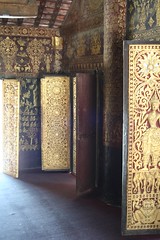
Inside Wat Xieng Thong

Every morning we started the day with breakfast at the Scandinavian Bakery (who knew the Swedes had a reputation for things cooked in the oven?), which serves great pastries, delicious sandwiches and all-you-can-drink fresh brewed coffee. Every evening Angela finished the day with a few hours of hunting for bargains at the Night Market on the main street; luckily she had Rahel to keep her company among the mountains of cuteness set for display on the pavement, and I was able to spend this time online, keeping up with the blog and uploading photos. The nights weren’t much to talk about; we’d celebrate our trip with a few more bottles of Beerlao or glasses of wine - there’s a swanky, well-stacked wine bar on the main street in Luang Prabang - but the whole town shuts down around 11PM and the only place to hang out was mama’s terrace at the guesthouse.

Wet and happy!

Between morning coffee and evening-time Beerlao, the days in Luang Prabang can be packed with activities. There are only so many temples that one can visit before they all start looking “same same”; the Phu Si hill, located smack in the middle of town offers great views, but after climbing the few hundred steps to the top, baking slowly under the unforgiving sun, anyone would be beset by doubts that the photo opportunities were not worth the effort and sweat. For the rest of the time, short of spending money in the scores of good-looking cafes and restaurants meant for the tourist dollar it’s better to head outside of town for a river trip, to visit caves or to swim at the waterfalls. On our third day, we took a half-day trip to Tat Kuang Si, a scenic waterfall a half-hour drive away from town. We were supposed to get wet swimming in the natural pools at the base of the falls, but we ended up getting dunked and drenched on our way back by the kids who ambushed every car, truck and motorcycle and doused them with buckets of water. They were getting a bit of advance practice for the water festivities of the Lao New Year, and it seemed that the season for splashing farang was already open. They had no mercy.

Published from Chaing Mai, Thailand.

Click here to read more...

Thursday, April 10, 2008

Vang Vieng

The road to the river
Click photo to see slideshow
or here for all Vang Vieng pics

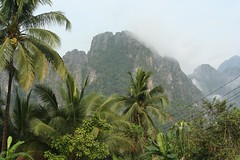
If you take Lonely Planet seriously you would think that Vang Vieng has graduated into the Major League of non-stop party scenes, right there with Bangkok's Khao San road, The Strip and Ibiza. The reality however, is not nearly as frightening as that. Sure, Vang Vieng has already become a fixture on the Laos backpacking circuit, a mandatory stop on the South-East Asia tourist trek, and for good reasons. Tubing (while drinking, optionally) down the Nam Song river is drawing a steady stream of enthusiastic, boisterous water-splashers; the more adventurous fill their day with adrenaline-loaded activities like caving, kayaking and rock-climbing; the scenery is breathtaking, the jagged karst mountains jutting out of the rice fields, dominating the landscape for miles.

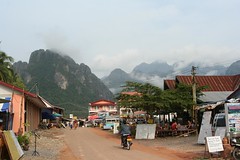
Still peaceful

On the more decadent side, in what has become a trademark of the Vang Vieng experience, many restaurants play endless reruns of Friends on their street-side open patios, drunk falang in their bathing suits waddle their way in the middle of the street to the next bar, and the famous happy-shakes are more popular than ever. But the charm of the place has not yet been spoiled by unrestrained partying. In fact, I found the town rather quiet; there were few tourists around and no loud music was blaring from speakers at the bars. The vibe was peaceful... still. Perhaps the fact that all of Laos more-or-less shuts down at 11pm plays a role in that.

We didn't stay here too long, only enough to have a drink at a riverside restaurant admiring the magnificent sunset over the mountains and to do a bit of tubing the next day. Angela and our travel-friend Rahel did the tubing, I did the drinking...

Posted from Chiang Mai, Thailand.

Click here to read more...

Monday, April 7, 2008

The most relaxed capital in the world

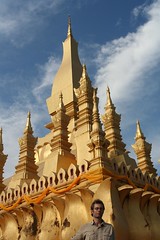
The Great Stupa
Click photo to see slideshow
or here for all Vientiane pics

There's not a lot you can do as a tourist in Vientiane. Sure, you can take pictures of the the photogenic Great Gilded Stupa, you can visit a few peaceful Buddhist wats, or you can stroll along the corridors of the National Museum through exhibits about the revolutionary history of Laos. But most of all, you will end up appreciating the restaurants that this town has to offer. The locals seem to be very proud of their flimsy French colonial heritage; bakeries, cafes, croissants and wicker chairs are pleasant fixtures of the city center streets. Many appealing, tastefully decorated dining establishments boast international cuisine on their menus - there is even a Mexican Taqueria on the river front - and most offer a very good, tasty deal for your money.

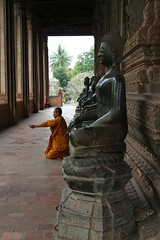
Tech-savvy monk

Surprisingly, the first few hotels we looked at as we got off the night bus from Pakse, were all booked solid. After wandering around in circles a few times, increasingly frustrated, looking at the "full" signs set up on top of many reception counters, we found a decent room at the Orchid Guesthouse, with bathroom, TV and air conditioning for $16. It was a little expensive, considering that Laos was supposed to be still one of the cheapest tourist destinations, but it seems that the Lonely Planet effect is being felt around here as well. As soon as something is listed in one of their famous, popular guidebooks the prices increase, sometimes up to double. You cannot negotiate much for room rates in Laos, even less so in remote rural areas like the Bolaven Plateau; more than once we arrived at guesthouses that were practically empty, yet they wouldn’t budge when I tried to haggle. Prices increase naturally over time, and the dollar is at a historic low nowadays, but these sudden radical adjustments of the most recent published rates seem only motivated by the greed of local businesses and the willingness of the tourists to pay without questioning. In the words of a bitter forum member on the Thorntree message board: "I travel with a f#@%*! Lonely Planet guide only so I know to avoid all the places listed in there!"

No incoming traffic?

One day is all you need in Vientiane if you don't have any special business to attend to. I did - I had to apply for another tourist visa to enter Thailand again; unfortunately Romania is not on the list of the countries whose citizens are exempt of visas or can receive them on arrival. The process was as easy as ever: you stay in line to apply, you wait in a stifling room for your name to be called so you can pay the 1000 baht fee (about $30) and you pick up your passport the next day. And since Vientiane is a small town, I didn't even need to pay for a taxi to take us to the consulate and back - we rented bicycles and explored the town on wheels; the flat land and the absence of heavy traffic makes biking a very appealing alternative to tuk-tuks.

After two days we continued on our way north - the next stop was Vang Vieng, the backpacker's mecca in the mountains of northern Laos.

Published from Luang Prabang

Click here to read more...

Saturday, April 5, 2008

Rural adventures in southern Laos

Tubing on the Mekong at dusk
Click photo to see slideshow
or here for all Don Det pics

As soon as I got off the boat in Don Det I knew it was the place I’ve been hoping for. I had seen too many crowded cities, busy paved roads, hassling tuk-tuk drivers and growling tour buses. Without even knowing it I had been longing for a hammock under the shade of trees by the riverside. I had been dreaming of a peaceful village with no cars and few people, a haven of silence with dirt paths and bamboo bungalows where the morning crow of the roosters and the music of the roaring waterfalls would be the only disturbing noises. Then our long-tail boat landed on a muddy river bank in Don Det. I was in backpacker heaven.


Our bungalows - Vixay guesthouse

At the southern tip of Laos, the Mekong River spreads into a maze of arms and canals, snaking its way through and around the swarm of islands that dot its waters. Don Det, the most famous outpost in the Four Thousand Islands, is where the crowd of international modern-day hippies goes for a swim, a beer, and countless hours of just watching the waters flow. The islands still live in a time of their own; the local families tend to their riverside guesthouses and patio-restaurants when they are not busy cultivating rice. Electricity is a daily four-hour festival, between 6 and 10 PM. There are no cars, only a few scooters. Nobody runs; everybody seems to be taking a stroll. If you’re looking for the deepest meaning of the words “slow” and “relaxed,” Don Det is the place for you. The French have tried, with little success, to build some infrastructure – a short railroad, a bridge and a few concrete dams – in order to circumvent the furious waterfalls that make the navigation toward the lower Mekong impossible. After their departure, everything fell into ruins.

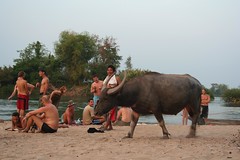
Beach life in Don Det
The tourists, mainly young backpackers and aged hippies, haven’t destroyed the place yet since it’s been “discovered”, about 10 years ago; they’re mostly busy socializing at the small beach on the northern tip of the island, biking their way around, swimming in the natural pools at the Tat Somphamit waterfalls and getting high on the widely available, cheap ganja. The lack of permanent electrical power contributes in part to keeping the islands isolated and underdeveloped; everyone who loves them would like them to stay so. For as underdeveloped as they are, the islands don’t lack the basic commodities needed by 21st-century backpackers – beer, kept in coolers under blocks of ice, is usually cold enough despite the lack of refrigerators; internet, albeit expensive, is available (running on batteries outside of the electricity window) and in every hamlet lives at least one guy who can fix a flat tire – a skill sorely needed by many falang who rent bikes to explore Don Det and Don Khon (its sister island to the south). During our own biking adventure, Angela’s wheels punctured and deflated three times, the same day. Bad luck or bad karma?

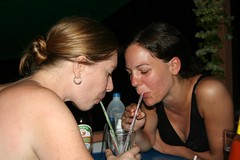
Angela and Rahel sipping a Lao-Lao shake

Many people stay on the islands longer than they planned, but “slow” and “relaxed” can become “boring” after a while. We left after three days and took a sawngthaew (a sort of pick-up truck turned bus) to Pakse, the closest bigger town on the Mekong and a former French colonial provincial capital. After peace and quiet we were now missing the creature comforts of modern life: TV, better food and air conditioning. It was time for a bigger adventure: a motorbike tour of the Bolaven plateau. Lonely Planet recommends the plateau, its jungle-covered mountains, the spectacular waterfalls, and the dirt roads winding through sleepy villages as one of the main attractions of southern Laos; we took their word for it and followed the circuit they suggested.

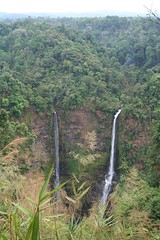
Tad Fan Waterfalls
Click photo to see slideshow
or here for all Bolaven plateau
photos

We left Pakse with our 100cc 4-speed Honda on a rainy morning. As we woke up with the dark skies and warm rain we hesitated for a while; should we just skip the whole plateau-thing and head straight to Vientiane? But we didn’t give up; we left the big backpacks at the Lankham hotel and hopped on the bike with the day bag, a change of clothes, the camera and the computer (which we did not need, but couldn't leave behind). Within minutes my shirt was drenched and we had to stop at the market to buy plastic rain coats. As we arrived frozen and wet at the Tad Fan resort, where we wanted to have lunch at the restaurant overlooking the waterfalls, we were already having second thoughts. What if it was going to rain like that for the next few days? Fortunately it didn’t; the weather got better in the afternoon and by the time we arrived in the Tad Lo village, where we were going to spend the night, the skies had cleared and our clothes had dried.

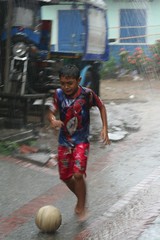
Kids playing Thai footbal in Tad Lo village

Tad Lo village is a perfect spot to while away a day or two in perfect harmony with nature. There are a few guesthouses with decent restaurants on the banks of the river, a short distance from the waterfalls, and only a handful of quiet backpackers. Unlike in Don Det, where all foreign tourists behave like one big family, there’s none of that overbearing socializing in Tad Lo; you’d almost want to talk in a whisper to your mate at the restaurant so you won’t disturb the divine peace that surrounds the village…

Foreigners come to the villages and towns of the plateau but not in large numbers, and the locals are always forthcoming and eager to practice the few words of English they know. In Attapeu they changed the TV channel to CNN when we sat down in a restaurant; they were happy and surprised when we told them we wanted the Lao traditional noodle-soup for breakfast instead of the omelets and baguettes they expected every falang to eat in the morning.

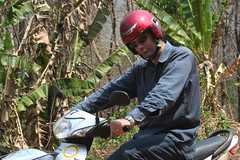
Bike warrior

Driving a bike up and down on the potholed dirt roads of the plateau is no easy affair. Storms broke out a couple of times; we had to stop and take cover under an abandoned house with some Lao boys who were kindling a scrap-wood fire. Another time, as the rain started to pour, a woman invited us in her house; her kids were staring at us the whole time, not sure whether they should laugh or be horrified. And when we thought things were just going great we got into an accident – I tried to avoid two consecutive potholes and the back wheel went skidding out of control. Before we knew it, we were reeling in the dirt, trying to figure out what happened, and the whole village was running toward us to help. Luckily we got away with a few superficial skin wounds, and the bike was fine. We were able continue our drive but we were hurting badly and decided to push all the way back to Pakse to treat our wounds – there was not much in the way of hygiene and medical help in Paksong, a small town in the heart of the plateau, where we had hoped to clean up and spend the night.

Road food
Our travel medical kit was more than enough, but out of sheer curiosity and a sense that a professional would do a better job, I decided to go to the local hospital. Surprisingly, it was all very clean and the nurses who treated us did a great job – but then again, they didn’t have to do much; they only cleaned the wounds, rubbed in some iodine and applied sterile plasters. Before long, we were entertaining the whole hospital staff with stories from the trip and bits of information about America. Treatment was free but we had to buy some cheap medical supplies, painkillers and antibiotics. Later that night, we celebrated the return to civilization and our narrow escape from an accident that could have turned much worse, with copious amounts of western food, beer and wine. The next day, we slept.

falang (or farang): generic word used in Thailand, Cambodia and Laos to describe foreigners of European ancestry. A bit like "gringo" in Central and South America.
Posted from Luang Prabang, Laos.

Click here to read more...