Run the equator: Spain
Showing posts with label Spain. Show all posts

Monday, December 17, 2007

Barcelona

“It’s 370 Euros for the seven nights, pay ahead,” the guy at the front desk said. Making a quick calculation, I frowned: “We don’t have so much money with us now, but in any case, when we talked on the phone you told me it was 50 Euros per night, so this doesn’t add up.”
“No, I told you 60 Euros.”
“You already charged my credit card for one night, 50 Euros as we agreed.”
“No that was just the deposit; the rate is 60 per night, due on arrival for the whole stay.”
“Now… you may have said something about the payment being due on arrival, I think I remember, but it was definitely 50, not 60 Euros per night.”
“Ok, ok, 50, I don’t care, I don’t want to argue. You can pay the whole sum tomorrow morning.”
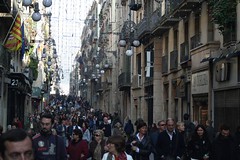
Craziness in the Barri Gotic
Click on pic to see slideshow
or here for the Barcelona set

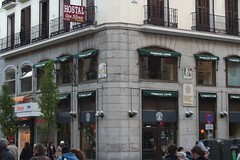
This conversation was taking place at 1AM on our arrival night in Barcelona, at the hotel Rembrandt, first in Spanish, and then in English - the guy nursing the reception desk at that late hour was an Indian and all three of us naturally drifted to the one language we could best use for arguing. He was clearly trying to scam us (later on I found the notes that I took when I booked the room on the phone, and I had indeed written down 50 Euros for the room with bathroom, and 40 for the one without) but we didn’t agree on what to do: Angela became angry and wanted to leave immediately; I advocated sleeping there for the night and leaving the next morning - it was already late, and finding another suitable hotel at that hour wouldn’t have been easy. To minimize the damage, I made sure the guy agreed he wouldn’t ask for more money besides the 50 Euros he had already charged us, and I made clear we won’t pay before the next day, if we decided to stay. I had my way, but not without getting an earful from Angela, how “this isn’t right and we should have left immediately!” I appreciate people with principles, but only when it doesn’t imply dragging a 50-pound backpack about the streets in the middle of the night… The moral of the story: don’t go to Hostal Rembrandt in Barcelona, even if it’s featured in Lonely Planet. It’s a dump, and you can find better budget hotels at a cheaper price. Besides, you’ll avoid an argument with your wife, if things go sour…
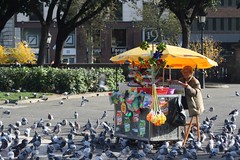
Flying rats in Placa Catalunya

All ended up fine the next day as I found the Hotel Principal (two stars), which, for being more pricey (80 Euros), offered all the comforts longed for by backpackers who had been sleeping for too long in cheap hostels: a large, tall room, a view to the street, a gigantic bed, TV (although all channels except for EuroNews were in Spanish), hard-wood floors, silent air conditioning that actually responded to the temperature controls, and a bathroom with futuristic showers that required a PhD to operate. It even had “original artist paintings” (touted as such in the hotel brochure) on the walls – maybe that’s why the extra Euros… the starving artists who had sold their hearts to the necessary evil of corporate design had to make a buck too. No breakfast was included, but internet access, including wireless, was. I didn’t balk when I heard the price; I got it as soon as I saw the room.
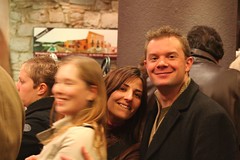
Fun with Eva and Robert
at a basque eatery

For us, after so many cities visited, Barcelona was just another big town, albeit one that you can fall in love with in the long run. It isn’t a flashy poser like Rome but a city that slowly grows on you because of its very distinct personality. Food… well, food just kept getting better. You can’t be wrong if you had three shots at the culinary art of a country (Madrid, Seville and Barcelona) and things have steadily gone from better to best. Spanish cuisine is now definitely the sweetest of my love-affairs with food.
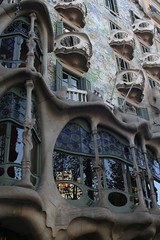
Casa Battló

What do you do if you’re a tourist in Barcelona? You climb up the escalators to Montjuic and snap some uninspired panoramic photos of the city below; then you sit and relax watching the kids at play in the beautiful terraced gardens that take you back into town; you walk the never-ending blocks with “shaved” corners in the Eixample and get lost in the all-identical streets; you visit the Picasso museum and stare in amazement at the many cubist studies of Velasquez’s Las Meninas; you stroll up and down the Ramblas and enjoy the crazy crowd of passersby, gawkers and living statues; you cannot miss a visit to the Sagrada Familia temple, and if you still have energy and taste for architecture you go and see the Gaudi houses – Casa Battló and La Pedrera - at least from the outside, if you’re not willing to spend the money to get in. And these are just some highlights…
I just can't look normal in pictures!

In Barcelona I met Robert again, my Dutch friend that I knew from my Nuremberg days in 1999/2000, when we both worked for Lucent Technologies, and with whom I somehow kept in touch all those years. He brought along the lovely, wry, sharp-tongued Eva, his Spanish long-distance girlfriend. We went out every night, taking the city by storm, one restaurant at a time and got home mostly drunk, defeated by the abundance of exquisite tapas and good wines. To them I owe the fact that I finally saw the “Bodies” exhibition. If they hadn’t insisted that they wanted to go and that Eva could get cheap tickets using some “points” from previous purchases, I wouldn’t have bothered dishing out the 17 Euros for the regular entrance. This exhibition had been on display for months at the convention center, two blocks down the street from our apartment in Seattle, and I didn’t bother visiting – not because of the price (in any case it was lower than in Europe) but because of lack of interest. I had to admit it was in fact very interesting and instructive, although by the time I got to the second room I had developed an uneasy feeling that didn’t leave me for the rest of the time I spent inside: I became aware of my heart pumping blood, my bowels working and my nerves trying to transmit vital impulses… If you are still smoking, the Bodies exhibition will make you want to quit… at least until you get out and light one up…

Published from Cluj-Napoca, Romania.

Click here to read more...

Wednesday, December 5, 2007

Nothing to do in Seville

When in Seville, do what the locals do
Click on pic to see slideshow
or here for the Seville set

As we boarded the train at the Atocha station in Madrid, we had lots of plans for the four or five days we were going to spend in Andalucía. But when we arrived in Seville everything fizzled out little by little and we ended up spending the next three days eating well and shopping. First, the plan to travel to Granada petered out; taking the train or bus there and then getting from Granada to Barcelona was going to cost too much. So when we found a cheap plane ticket from Seville straight to Barcelona we decided to forgo the Alhambra. In Seville itself, we weren’t very proficient with the monuments – we walked the beautiful narrow streets of the old town but didn’t enter one single tourist attraction. The magnificent Seville cathedral was charging 7.50 Euros entrance fee, and I decided that the Catholic Church would not have my money anymore. If I can’t get into a church for free, I won’t get in at all (although I was going to break this oath later at the Sagrada Familia in Barcelona).

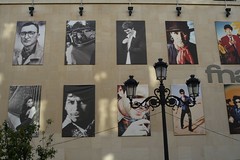
The fnac megastore

We compensated our lack of cultural interest by spending a lot of time at fnac (the French cultural and consumer-electronics megastore) and El Corte Ingles, buying the iPod Nano G3, and downloading a lot of music. And no doubt, we redeemed ourselves by sampling the elaborate culinary offerings of the many tapas bars spread all over town. “Es arte, no es cocina,” the waitress at Los Coloniales told us as she brought a delicious plate of sandwiches with foie gras and cold roasted pork cuts, topped with fried quail eggs. I licked my fingers knowing I have reached a new apex of culinary delight. And things were going to get even better…

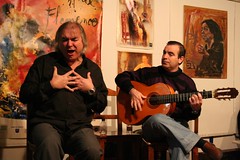
Flamenco drama!

In defense of “traditional” cultural activities, on one of the evenings we went to see a free flamenco show in a bar. The singer and the guitar player put up a good, passionate performance, but it was not amplified, and a lot of the people in the back of the bar kept on talking. The background noise bothered the singer (who had to keep reminding the audience not to speak and not to smoke) and annoyed the people who were actually there for the music. Of course, if the show hadn’t been for free, this wouldn’t have happened.

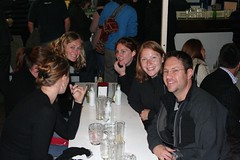
Paul and some girls

The Oasis Backpacker Hostel, our lodgment in Seville, is a nice renovated building with a great location, but, as it happens with most places which have “backpackers” in their name, it is very loud. The hotel is built around a small inner courtyard which has been covered with a glass roof, and now holds the reception, a few couches and the computers with free internet access. As such, this makeshift “lodge” is a very popular place, and it’s no surprise that the rooms at the higher floors get a share of the conversations that happen downstairs. The hostel seemed to be full with nothing but young American students, most of them girls; the word “like” kept popping up in their conversations - which were mainly about drinking or bad boyfriends - with an unprecedented frequency. But among all those aliens we meet Paul, an American traveling alone around the world not for one, but for two years (of which he has completed half). We spent some time with him exchanging travel ideas and blog tips (is there even one person traveling for a long time nowadays, who doesn’t keep a blog?). He has lots of stories and good pictures at http://pauls-paradigm2.blogspot.com.

At the end of the three days, we left Seville largely unexplored and headed for Barcelona hoping for good weather, more good food, and eager to meet my friend Robert whom I hadn’t seen in something like 5 years…

Written in Barcelona

Click here to read more...

Thursday, November 29, 2007

Living la vida loca!

Forget falafel, forget tzatziki, forget pizza and pasta – in Spain we have reached culinary Nirvana. Tapas-hopping is a wonderful Spanish tradition that turns dinner (or lunch) into a bar-crawl. You eat a few olives here, some grilled prawns there, a portion of stuffed champignons here and some chorizo or roasted pig-ear in yet another place, all sprinkled with lots of your favorite wine or beer. Of course, these make just a very modest list; in reality, the variety of foods served at any tapas bar is enough to keep newcomers busy experimenting with strange or unfamiliar foods for weeks.

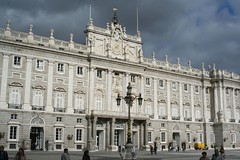
Palacio Real
Click on pic to see slideshow
or here for the Madrid set

As in many European countries, you can still smoke in bars and restaurants in Spain, and cigarettes are available from numerous automated dispensers. The locals take ample advantage of this benefit and you’ll be hard-pressed to find even a restaurant that has a non-smoking section. But things are changing – a few popular places, mostly chain-style restaurants, have started to display very conspicuous non-smoking signs, and people seem not to mind the restriction and still flood these establishments. Where smoking is allowed (and that is almost everywhere), explicit signs say “Esta permitido fumar,” but the same signs also mention that smoking can be harmful and cause heart and lung disease. In my opinion it is just a question of time before Spanish smokers will be forced to take their cigarettes outside, like they are now in Italy.

Starbucks!

Madrid doesn’t have the intense and overwhelming beauty of Rome, but its charm is nevertheless undeniable, primarily because of the crazy, outgoing, fun way of life that Spaniards have adopted. The downtown streets are full of people every evening, bars (including those that serve food) stay open very late - they close just in time for the nightclubs (some still called “discos”) to open, and no Spaniard seems to be ever having dinner at home, despite the high prices (yes, we had a round of drinks in a bar where every alcoholic beverage on sale, except for the beer, was 14 Euros - have you ever tried a screwdriver for $20?). This propensity for social life and long-lasting parties comes as no surprise after the 36 years of hard repression by the Franco regime, when the country was in a permanent curfew. Indeed, as a bitter joke, bars and restaurants have kept on their walls the menacing warning signs of the dictatorship era: “Prohibido cantar y bailar” (singing and dancing prohibited) say those engraved plaques, screwed in the tiles above the heads of the cheering crowd. Never again, the jolly Madrileños seem to reply.

Plaza Mayor

Despite this atmosphere of freedom and relaxation, Spain is well aware that it has been caught in the middle of a sinister war, the war on terror. I’m not sure whether this has happened before or in the aftermath of the Madrid train bombings, but Spain, like the US, has sacrificed some convenient freedoms for the greater (some may dispute the adjective) benefit of increased security. Larger railway stations, which in Europe have always been places where you can run to the platforms and hop on the train at the last minute, have become more like airports – the platforms are now fenced out from the waiting halls by sturdy, tall cast-iron railings, and access to the train happens through a scanner gate where, akin to the security checks at airports, all bags are x-rayed.

A sunny day at the Prado

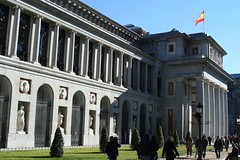
In other, more personal news, after all those museums full of statues and ancient mosaics and the archaeological sites we saw in Rome, switching our focus to “painting appreciation” has been a welcome change. Madrid has two of the most famous art museums in the world – the Prado, home to most of Goya’s and Velasquez’s works, where lines for tickets are permanently winding around the building during opening hours, and the Reyna Sofia, which boasts a fantastic collection of modern art, including the gripping Guernica (along with many other works by Picasso), a few rooms of Dali, and – in my uneducated opinion – too much of the over-appreciated Miro.

The city’s ferial atmosphere has cast its spell on us enough to convince even me to do some shopping. I bought a winter coat; my Marmot jacket can only help when winter temperatures are still bearable (like in Argentina or Greece), and besides, after 7 months of traveling it has accumulated dirt and food spots to the point that I have become ashamed to go into town wearing it. I was sad when we left Madrid; 5 days in this city had not been enough; we could have easily enjoyed a few more. But we were heading south for Seville and I could not resist the call of warmer weather…

Posted from Barcelona.

Click here to read more...