Run the equator

Thursday, April 10, 2008

Vang Vieng

The road to the river
Click photo to see slideshow
or here for all Vang Vieng pics

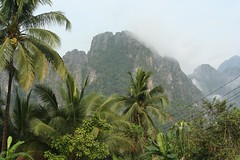
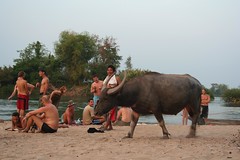
If you take Lonely Planet seriously you would think that Vang Vieng has graduated into the Major League of non-stop party scenes, right there with Bangkok's Khao San road, The Strip and Ibiza. The reality however, is not nearly as frightening as that. Sure, Vang Vieng has already become a fixture on the Laos backpacking circuit, a mandatory stop on the South-East Asia tourist trek, and for good reasons. Tubing (while drinking, optionally) down the Nam Song river is drawing a steady stream of enthusiastic, boisterous water-splashers; the more adventurous fill their day with adrenaline-loaded activities like caving, kayaking and rock-climbing; the scenery is breathtaking, the jagged karst mountains jutting out of the rice fields, dominating the landscape for miles.

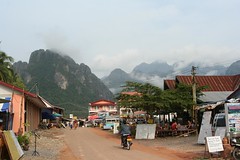
Still peaceful

On the more decadent side, in what has become a trademark of the Vang Vieng experience, many restaurants play endless reruns of Friends on their street-side open patios, drunk falang in their bathing suits waddle their way in the middle of the street to the next bar, and the famous happy-shakes are more popular than ever. But the charm of the place has not yet been spoiled by unrestrained partying. In fact, I found the town rather quiet; there were few tourists around and no loud music was blaring from speakers at the bars. The vibe was peaceful... still. Perhaps the fact that all of Laos more-or-less shuts down at 11pm plays a role in that.

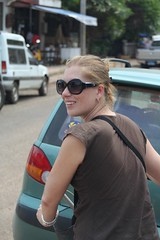
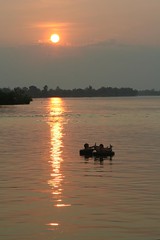
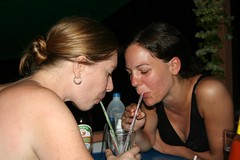
We didn't stay here too long, only enough to have a drink at a riverside restaurant admiring the magnificent sunset over the mountains and to do a bit of tubing the next day. Angela and our travel-friend Rahel did the tubing, I did the drinking...

Posted from Chiang Mai, Thailand.

Click here to read more...

Monday, April 7, 2008

The most relaxed capital in the world

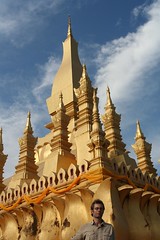
The Great Stupa
Click photo to see slideshow
or here for all Vientiane pics

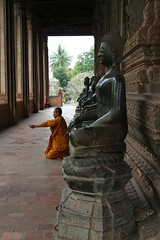
There's not a lot you can do as a tourist in Vientiane. Sure, you can take pictures of the the photogenic Great Gilded Stupa, you can visit a few peaceful Buddhist wats, or you can stroll along the corridors of the National Museum through exhibits about the revolutionary history of Laos. But most of all, you will end up appreciating the restaurants that this town has to offer. The locals seem to be very proud of their flimsy French colonial heritage; bakeries, cafes, croissants and wicker chairs are pleasant fixtures of the city center streets. Many appealing, tastefully decorated dining establishments boast international cuisine on their menus - there is even a Mexican Taqueria on the river front - and most offer a very good, tasty deal for your money.

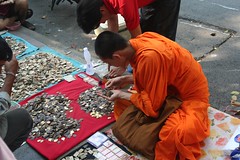
Tech-savvy monk

Surprisingly, the first few hotels we looked at as we got off the night bus from Pakse, were all booked solid. After wandering around in circles a few times, increasingly frustrated, looking at the "full" signs set up on top of many reception counters, we found a decent room at the Orchid Guesthouse, with bathroom, TV and air conditioning for $16. It was a little expensive, considering that Laos was supposed to be still one of the cheapest tourist destinations, but it seems that the Lonely Planet effect is being felt around here as well. As soon as something is listed in one of their famous, popular guidebooks the prices increase, sometimes up to double. You cannot negotiate much for room rates in Laos, even less so in remote rural areas like the Bolaven Plateau; more than once we arrived at guesthouses that were practically empty, yet they wouldn’t budge when I tried to haggle. Prices increase naturally over time, and the dollar is at a historic low nowadays, but these sudden radical adjustments of the most recent published rates seem only motivated by the greed of local businesses and the willingness of the tourists to pay without questioning. In the words of a bitter forum member on the Thorntree message board: "I travel with a f#@%*! Lonely Planet guide only so I know to avoid all the places listed in there!"

No incoming traffic?

One day is all you need in Vientiane if you don't have any special business to attend to. I did - I had to apply for another tourist visa to enter Thailand again; unfortunately Romania is not on the list of the countries whose citizens are exempt of visas or can receive them on arrival. The process was as easy as ever: you stay in line to apply, you wait in a stifling room for your name to be called so you can pay the 1000 baht fee (about $30) and you pick up your passport the next day. And since Vientiane is a small town, I didn't even need to pay for a taxi to take us to the consulate and back - we rented bicycles and explored the town on wheels; the flat land and the absence of heavy traffic makes biking a very appealing alternative to tuk-tuks.

After two days we continued on our way north - the next stop was Vang Vieng, the backpacker's mecca in the mountains of northern Laos.

Published from Luang Prabang

Click here to read more...

Saturday, April 5, 2008

Rural adventures in southern Laos

Tubing on the Mekong at dusk
Click photo to see slideshow
or here for all Don Det pics

As soon as I got off the boat in Don Det I knew it was the place I’ve been hoping for. I had seen too many crowded cities, busy paved roads, hassling tuk-tuk drivers and growling tour buses. Without even knowing it I had been longing for a hammock under the shade of trees by the riverside. I had been dreaming of a peaceful village with no cars and few people, a haven of silence with dirt paths and bamboo bungalows where the morning crow of the roosters and the music of the roaring waterfalls would be the only disturbing noises. Then our long-tail boat landed on a muddy river bank in Don Det. I was in backpacker heaven.


Our bungalows - Vixay guesthouse

At the southern tip of Laos, the Mekong River spreads into a maze of arms and canals, snaking its way through and around the swarm of islands that dot its waters. Don Det, the most famous outpost in the Four Thousand Islands, is where the crowd of international modern-day hippies goes for a swim, a beer, and countless hours of just watching the waters flow. The islands still live in a time of their own; the local families tend to their riverside guesthouses and patio-restaurants when they are not busy cultivating rice. Electricity is a daily four-hour festival, between 6 and 10 PM. There are no cars, only a few scooters. Nobody runs; everybody seems to be taking a stroll. If you’re looking for the deepest meaning of the words “slow” and “relaxed,” Don Det is the place for you. The French have tried, with little success, to build some infrastructure – a short railroad, a bridge and a few concrete dams – in order to circumvent the furious waterfalls that make the navigation toward the lower Mekong impossible. After their departure, everything fell into ruins.

Beach life in Don Det
The tourists, mainly young backpackers and aged hippies, haven’t destroyed the place yet since it’s been “discovered”, about 10 years ago; they’re mostly busy socializing at the small beach on the northern tip of the island, biking their way around, swimming in the natural pools at the Tat Somphamit waterfalls and getting high on the widely available, cheap ganja. The lack of permanent electrical power contributes in part to keeping the islands isolated and underdeveloped; everyone who loves them would like them to stay so. For as underdeveloped as they are, the islands don’t lack the basic commodities needed by 21st-century backpackers – beer, kept in coolers under blocks of ice, is usually cold enough despite the lack of refrigerators; internet, albeit expensive, is available (running on batteries outside of the electricity window) and in every hamlet lives at least one guy who can fix a flat tire – a skill sorely needed by many falang who rent bikes to explore Don Det and Don Khon (its sister island to the south). During our own biking adventure, Angela’s wheels punctured and deflated three times, the same day. Bad luck or bad karma?

Angela and Rahel sipping a Lao-Lao shake

Many people stay on the islands longer than they planned, but “slow” and “relaxed” can become “boring” after a while. We left after three days and took a sawngthaew (a sort of pick-up truck turned bus) to Pakse, the closest bigger town on the Mekong and a former French colonial provincial capital. After peace and quiet we were now missing the creature comforts of modern life: TV, better food and air conditioning. It was time for a bigger adventure: a motorbike tour of the Bolaven plateau. Lonely Planet recommends the plateau, its jungle-covered mountains, the spectacular waterfalls, and the dirt roads winding through sleepy villages as one of the main attractions of southern Laos; we took their word for it and followed the circuit they suggested.

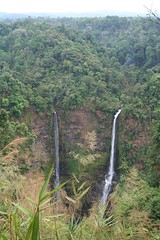
Tad Fan Waterfalls
Click photo to see slideshow
or here for all Bolaven plateau
photos

We left Pakse with our 100cc 4-speed Honda on a rainy morning. As we woke up with the dark skies and warm rain we hesitated for a while; should we just skip the whole plateau-thing and head straight to Vientiane? But we didn’t give up; we left the big backpacks at the Lankham hotel and hopped on the bike with the day bag, a change of clothes, the camera and the computer (which we did not need, but couldn't leave behind). Within minutes my shirt was drenched and we had to stop at the market to buy plastic rain coats. As we arrived frozen and wet at the Tad Fan resort, where we wanted to have lunch at the restaurant overlooking the waterfalls, we were already having second thoughts. What if it was going to rain like that for the next few days? Fortunately it didn’t; the weather got better in the afternoon and by the time we arrived in the Tad Lo village, where we were going to spend the night, the skies had cleared and our clothes had dried.

Kids playing Thai footbal in Tad Lo village

Tad Lo village is a perfect spot to while away a day or two in perfect harmony with nature. There are a few guesthouses with decent restaurants on the banks of the river, a short distance from the waterfalls, and only a handful of quiet backpackers. Unlike in Don Det, where all foreign tourists behave like one big family, there’s none of that overbearing socializing in Tad Lo; you’d almost want to talk in a whisper to your mate at the restaurant so you won’t disturb the divine peace that surrounds the village…

Foreigners come to the villages and towns of the plateau but not in large numbers, and the locals are always forthcoming and eager to practice the few words of English they know. In Attapeu they changed the TV channel to CNN when we sat down in a restaurant; they were happy and surprised when we told them we wanted the Lao traditional noodle-soup for breakfast instead of the omelets and baguettes they expected every falang to eat in the morning.

Bike warrior

Driving a bike up and down on the potholed dirt roads of the plateau is no easy affair. Storms broke out a couple of times; we had to stop and take cover under an abandoned house with some Lao boys who were kindling a scrap-wood fire. Another time, as the rain started to pour, a woman invited us in her house; her kids were staring at us the whole time, not sure whether they should laugh or be horrified. And when we thought things were just going great we got into an accident – I tried to avoid two consecutive potholes and the back wheel went skidding out of control. Before we knew it, we were reeling in the dirt, trying to figure out what happened, and the whole village was running toward us to help. Luckily we got away with a few superficial skin wounds, and the bike was fine. We were able continue our drive but we were hurting badly and decided to push all the way back to Pakse to treat our wounds – there was not much in the way of hygiene and medical help in Paksong, a small town in the heart of the plateau, where we had hoped to clean up and spend the night.

Road food
Our travel medical kit was more than enough, but out of sheer curiosity and a sense that a professional would do a better job, I decided to go to the local hospital. Surprisingly, it was all very clean and the nurses who treated us did a great job – but then again, they didn’t have to do much; they only cleaned the wounds, rubbed in some iodine and applied sterile plasters. Before long, we were entertaining the whole hospital staff with stories from the trip and bits of information about America. Treatment was free but we had to buy some cheap medical supplies, painkillers and antibiotics. Later that night, we celebrated the return to civilization and our narrow escape from an accident that could have turned much worse, with copious amounts of western food, beer and wine. The next day, we slept.

falang (or farang): generic word used in Thailand, Cambodia and Laos to describe foreigners of European ancestry. A bit like "gringo" in Central and South America.
Posted from Luang Prabang, Laos.

Click here to read more...

Tuesday, April 1, 2008

The Indochina route

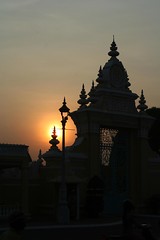
Sunset at the Royal Palace
Click photo to see slideshow
or here for all Phnom Penh
pictures

Getting to Cambodia from Bangkok on land is sort of a painful adventure, from what I’ve heard. Guide books and weathered backpackers advise against taking the minibus service to Siem Reap, the gateway to Angkor, offered by many Bangkok hotels and guesthouses. Apparently, the “direct” minibus deal is a major scam. The journey takes the whole day and the weary backpackers are dropped late at night at a commission-paying hotel, when they are too tired to set off and look for another guesthouse. A better alternative is to take public transportation to the Thailand-Cambodia border and arrange your transfer to Siem Reap once you crossed - there is no lack of options on the Cambodian side. Even then, the journey would not be much faster, since the road leading from the border to Siem Reap is in very poor shape. Conspiracy theory pundits maintain that the road is kept purposely in this state of disrepair, in order to bolster business for the only airline that links the two places, Bangkok Airways. Allegedly, Cambodian government officials receive solid kickbacks in exchange for keeping their eyes closed and allowing the status quo to continue. But that’s just a story… I’m sure that the money we paid to Bangkok Airways to fly us to Cambodia, about $200 per person for a 35-minute flight, will be used for a noble cause…

After exhausting ourselves scampering through the ruins of Angkor, the obvious next step was to travel to Phnom Penh, the capital of the country, the central hub where all roads lead to anyway. Luxury buses (luxury meaning that they have AC and a toilet) between Siem Reap and Phnom Penh take about 5 hours and cost $8. The road is paved and the ride uneventful.

The ravages of neglect

Phnom Penh, the largest town in Cambodia, still has the air of a sleepy colonial river outpost, boasting a nice French quarter with many renovated, charming buildings. Between 1975 and 1979, during the genocidal Khmer Rouge regime, the city was almost completely abandoned; the population was evacuated and sent to remote villages and reeducation camps. Its residents were labeled enemies of the people, unfit and unworthy to live in the new agrarian republic of Kampuchea; many were eventually killed. The infrastructure gradually collapsed; the plumbing system, unused for too long, decayed and broke down. Rebuilding efforts started soon after the demise of the communist regime, with the gradual return of the population. Today the town looks pretty good, considering what it’s gone through in the past. Business is booming; tourists, foreign NGO workers, and even Cambodians fill the fancy restaurants and cafes along the river; renovation projects and construction work are underway in many parts of town. Yet as charming as Phnom Penh is, it’s nothing to fall in love with. After a few uneventful days, which we spent mostly eating and watching TV in our $15 air-conditioned room at the “OK Guesthouse” - a favorite backpacker’s hangout - we moved on… but not before a last-day extravaganza, spending $50 for Spanish tapas and a bottle of red wine at one of the finest restaurants in town.

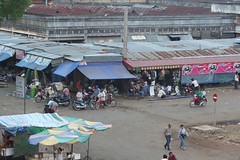
Stung Treng... center

Since there wasn’t much else to see in Cambodia, we continued creeping our way toward Laos. There aren’t any luxury liners on that route; we had to take a mosquito-infested local bus that stopped in every village. It wasn’t very cheap (at least for us foreigners) - $12 and about 9 hours will bring you not quite to the border, but to Stung Treng, the closest town, where bus services end. Locals don’t cross the border often, and when they do, they are more likely to be seen on motorbikes loaded with bags and crates in a precarious balancing act. Various Phnom Penh guesthouses that provide bus tickets to backpackers sell transportation all the way to the Laos border, without volunteering the information that you have to spend the night in Stung Treng. But you have no choice, the border closes early. In Stung Treng, another $13 will get you a ticket involving two river crossings and two road transfers, all the way to Four Thousand Islands - the backpacker’s haven on the Mekong River in the south of Laos. Surprisingly, the suspicious-looking guy who sold us this deal accepted the Phnom Penh-to-Lao-border ticket that one of the foreign travelers had; he only paid $8.

The shipping of backpackers into Laos is like a family affair around here; guesthouses, bus companies, ferry operators, border guards - everybody seems to get a piece of the pie. Things works on the “Cambodian hour,” which is not unlike the Mexican hour; you must double the time they give you, and add one hour here or there to account for the unavoidable delays. We were told we would leave at 7:30AM, but ended up on the bus around 10. No one would tell us - five increasingly annoyed falang backpackers - what was going on, or when we would finally leave. Straight answers are not the norm here; admitting failure would mean losing face. Magically, when you demand explanations or try to negotiate for a better price, nobody speaks English anymore. But maybe there was a problem on that day and maybe they did usually leave at 7:30… in any case we made it to the border, where a larger group of tourists going the other way was waiting for the bus to take them into Cambodia.

Crossing the border was a breeze... a money-smelling breeze. At the border post on the Cambodia side, a simple wooden shack on the side of the road, the surly guard stamped our passports with the exit visas. “One dollar each” he said, in a flat, matter of fact voice. I know it’s never wise to argue with border officials in third-world countries, but I couldn’t help asking “Why?” “Overtime work,” the answer came. “It’s Sunday.” We smiled and paid. Later Angela told me she was burning to say “No problem, we come back tomorrow,” just to see how they take it. I suspect stamping passports would be considered overtime work not only on weekends, but also during breakfast, lunch and siesta and in general, whenever tourists happen to arrive.

A van was waiting for us on the other side of the barrier, confirming that we hadn’t been scammed after all. A few hundred meters farther, at the Laos border post, we showed our visas, which we had obtained in advance through an agency in Bangkok, and filled our entry cards. “Two dollars each,” the guard said, holding my passport in his hand. “Why?” “Overtime work. It’s Sunday.” I paid without saying a word, but at the same time I was thinking that somebody should tell those suckers on the Cambodia side that they have to adjust the overtime fee, because their smarter Lao colleagues are making double the money for the same work…

Posted from Vientiane, Laos.

Click here to read more...

Wednesday, March 26, 2008

Of ruins, tuk-tuks and Lonely Planet books

An unforgettable first impression
Click photo to see slideshow
or here for all Angkor pictures

Cambodia - the cradle of the powerful Khmer empire in the old days - is a land that has gone through tormented recent times. It slumbered under a brief colonial French rule whose legacy can still be visible today; it achieved independence and survived the Indochina wars almost unscathed; it got its share of civil war between a corrupt western-backed government and ruthless, single-minded communist guerillas and wound up subjected to a horrifying social experiment performed by the genocidal Khmer Rouge. Yet the Cambodians still smile as they go through their days. Lately, after a period of turmoil following the return to monarchy and democracy (for lack of another word to describe the local medley of bickering political parties, military coups, and foreign influence) and the demise of the last Khmer Rouge guerillas, Cambodia’s wounds began to heal slowly. And what could spell “normalcy” better than a steady influx of western tourists and sustained hotel development? In fact, hotel building seems to be at an all-time high those days in Siem Reap, the provincial town used as a base to visit Angkor Wat - possibly the most famous ruin in Asia.

An afternoon in Siem Reap
Siem Reap still has a frontier-town air about it, with its charming old French quarter (now housing cafes, restaurants, bars and internet access points), with its cheap street-side food stalls and its lazy green river flowing peacefully to join the Mekong. The outskirts, however, have already begun to look like a fake resort town. The streets that radiate from the center toward the airport and the Angkor archaeological area are lined with vast luxury compounds boasting exquisite cuisine, flashy discos and relaxing piano-lounges. Their facades are bathed in mood-lighting at night; the lawns are perfectly manicured and the uniformed staff bows to open the doors when you arrive. Many of those new hotels weren’t even finished when we visited, but there is collective hope that the future will see interest in Angkor grow worldwide, which will materialize into a steady influx of package tours to fill the many new, expensive rooms. Understandably, the backpackers still prefer the cheaper guesthouses in town, within walking distance to Molly Malone's Irish Pub.

Mr. Meth, my driver for the day,
watches as his tire is being fixed

There are many ways to get to the Angkor ruins. You can take an organized tour – if you like to spend your day herded from site to site in an air-conditioned minibus, with a bunch of other clueless tourists, listening to a guide who will probably give you less historical information than your Lonely Planet book; you can rent a bike and pedal your lungs out in the searing heat that descends over the Cambodian plain by 9AM; or you can hire a tuk-tuk driver for the day and visit the sites of your choice at your own pace. Cambodian tuk-tuks are similar to rickshaws, but unlike those, they are built by attaching a two-wheeler passenger cart, seating up to four, to a regular motorbike. In my opinion, the extra comfort of a car is not worth the price increase over a tuk-tuk.

Reflection of Angkor Wat

A day-pass for the ruins will set you back $20 (or $40 for the 3-day pass) and you’ll count another $10 or $12 for the driver per day, sunrise to sundown. The three-day pass is the best option. You can’t see everything in one day; the heat will likely send you back to town early, in search of a cool corner and a chilled beer. Angkor Wat and The Bayon may be the most famous and well-preserved of the ancient Khmer temples and they will take a good chunk of your time, but in fact there are enough interesting ruins at Angkor to fill three days of slow-paced exploration, allowing for plenty of down-time to while away the unbearable afternoons. Climbing the worn-out stone stairs, following dirt paths through holy courtyards abandoned to the ruinous vegetation, jumping over giant crumbled masonry blocks brought back memories of our visits to the Mayan cities in Yucatan, almost a year ago. It was the same feeling, the same guilty pleasure of being a dumbfounded spectator to the silent show of broken, wasted glory from a bygone age.

Practically stoned

Cambodia doesn’t bother much with the money exchange business; as weak as the dollar is now, it is still the de-facto currency here. Unlike Ecuador - another dollar-based economy - Cambodians have their own money, the riel, but it seems to be mostly used for giving change under a dollar. Almost all prices are quoted in US$: hotel rooms, restaurants, tickets, groceries, museums. If you happen to have riel you can use those interchangeably, at a fixed rate of 4000 to the dollar. ATMs dispense dollars and traveler’s checks are redeemed in the same currency. Tourists are happy to see their buck going a long way – one dollar will get you a plate of fried rice or noodles on the street and most purchases are negotiable. Children try to sell you water and “cold-ish” drinks as soon as you get out of your tuk-tuk and are about to set off eagerly for the ruins, and after you come out, tired and worn out, heading back to your driver. And if you really don’t need another bottle of water beside the two that you’re already carrying in your backpack, you surely need some books, don’t you?

Old Buddha, new head

Maybe you want a guide for Angkor Wat, with nice aerial pictures and in-depth historical explanations? No thank you… Maybe you need a Lonely Planet guide for Cambodia, Vietnam or Laos for only 2 dollars? No, thanks… wait! Only two dollars for the most recent Lonely Planet edition!? How is that possible? You take the book in your hand and slowly flip through a few pages. Yes, it’s indeed the last edition and it definitely looks brand new, not a used copy abandoned by a tourist. But there’s something wrong about it, something you can’t identify immediately. It just doesn’t feel like a Lonely Planet book, it doesn’t fit and bend in your hand the same way. And then you suddenly realize – it’s a knockoff copy! Yes, even the photos are printed on glossy paper, but they are less shiny and the colors are rather dull and sometimes off the mark. The photocopied black-and-white text looks just a bit flawed, the maps show grainy bits of grey where the original pattern was too delicate. Some pages are a bit faded, where the toner had started to run out; they are not aligned properly so you can’t see the black markers that delimit the chapters when you look at the book sideways… still, for only two dollars… I have serious objections to buying illegally-copied intellectual property, but if I were traveling in Cambodia, desperately needing a guide book for my next destination I might chop off some of that moral integrity by way of reasoning that my purchase helps the local community...
The real thing
But we had already bought our genuine Laos LP guide in India, so there was no need to commit a moral crime… Later we realized that it’s not just Lonely Planet guide books that come fresh from the Cambodian printing presses; all the action, mystery and romance bestsellers that tourists usually read on vacation (including the dreadful Davinci Code) were lying on book stands wrapped in plastic, neatly photocopied from the original editions and bound into seemingly-genuine soft covers. On closer inspection they may look just a bit too cheap, but they would do the job just like the originals. Happy reading in Cambodia!

Posted from Pakse, Laos - we may not have much internet access for the next few days!

Click here to read more...
Tuesday, March 18, 2008

Everything goes in Bangkok

At 3AM I wake up suddenly: somebody is screaming in the street. Paaw-paw-paw-paw-paaaaw-paw! Ah, it’s Seven Nation Army by The White Stripes, I realize… clearly, no army is going to stop these guys in their tenuous, stumbling journey back to their hotel… or to the next bar. I go back to bed. At 4AM the roosters in the temple yard across the street start crowing, louder and longer with each cry, as if they were locked in a deadly contest for supremacy. There is no earplug in this world thick enough to dampen the sound of roosters crowing. And who would have thought… roosters, in the touristic heart of Bangkok?

Bangkok
Click photo to see slideshow
or here for all Bangkok pictures

Nonetheless, I forced myself back to bed; drunk tourists aren’t much of a nuisance at 4AM in Bangkok, when even the German poofta-poofta-poofta techno music has stopped on Khao San Road. And the roosters… well, I had to remind myself of that little quote by Saint Francis of Assisi: “God, grant me the serenity to accept the things I cannot change…” or at least to ignore them while I try to sleep. And sleeping well wasn’t that difficult: for once, we had decided against our preference for fan-only rooms and went for the more expensive air-conditioning option. It was worth all the 450 baht (about $15) we paid for it; in Bangkok’s crushing hothouse nights air-con is a very desirable commodity and a good investment for your peace of mind. Air-conditioned or not, decent budget hotels aren’t hard to find in the tourist district of Bangkok. Except for the guesthouses featured in Lonely Planet, which - good or bad - are usually booked solid, most hotels will have rooms available, no matter at what hour of the day or night you happen to land in Bangkok. But trust me, the 150 baht tiny single-person fan-only rooms at the Sawasdee hotel should have been used as cremation chambers instead…

Peaceful Bangkok

Bangkok is a city that you can easily fall in love with; it shows many different faces and has something for everyone: it’s brash and quiet, ultra-modern and historical, crazy and subdued, cheap and expensive; it’s a melting pot of Asian cultures and western influence, of tradition and modernism; it’s stylish, huge, and clean and it makes you want to eat all the time. For a slice of craziness it’s enough if you wander at night on Khao San Street, where the party never stops. For peace and quiet, visit one of the many wats (Buddhist temple complexes) spread around the city, preferably not one of the famous ones. And for style there’s always Siam Square and the never-ending row of malls on Rama I Boulevard. They are nothing like our pitiful suburban, single-level shopping avenues. Bangkok malls are cathedrals of glamour; they raise six, seven stories above the ground, without counting the multiplex cinemas on top.

Stressful Bangkok
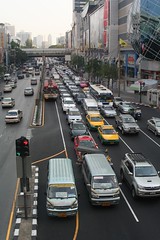
The more sophisticated establishments showcase Ferraris and Maseratis across from Prada and Gucci; the more popular and affordable choices are beehives of frantic cruising between stalls of cheap jewelry, knock-off designer wear, electronic gadgets and the food courts. Picture Pacific Place in Seattle… times 10. And then multiply that with small variations on both sides of the street for a mile or so! This shopping Mecca comes of course with a huge traffic problem; in the streets around Siam Square cars and buses seem to be stuck in the same spots for hours; the only relief comes from the Sky Train – an elevated transportation system that runs above the boulevard – but Thais, like Americans, seem to prefer their personal vehicles even at $4 a gallon…

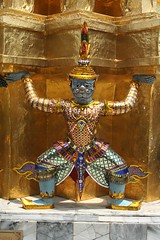
Temple protector

Displays of piety are common in Thailand; many people visit Buddhist shrines, lay offerings, pray and burn incense sticks. But for the westerner, the most striking act of devotion is that to the king. His serene face can be seen everywhere in Thailand: on billboards, on bank notes, on giant posters hung above the escalators in the malls, in the bus driver’s cabins, on flower-like monumental sculptures along the median strip of boulevards. The king is the first in everything: he is the foremost scholar, the best engineer, the first photographer (often shown with a camera hanging around his neck), the most hard-working agricultural worker, the wisest teacher, the most courageous army commander, the father of the country – all the symbolic attributes every communist totalitarian leader has tried to appropriate - have been granted to the king of Thailand by the own free will of the people, without violence or fear.

Royal pride
The Grand Palace guard
His persona is above all criticism; in a country like Thailand where governments are a-dime-a-dozen, politicians are corrupt and despised, and military coups are just another way of making politics the king is a unifying, deeply symbolic figure who gives strength and meaning to the life of the ordinary Thai people. We too stood up a few times and paid our silent homage to His Majesty, King Rama IX, before the movies started at the cinema (as a side note, we saw Rambo 4 – oh heavens, what were we thinking!, There Will Be Blood – weird but at least not boring, and 10,000BC – how much longer will Hollywood believe that special effects can make up for poor storylines, bad acting and worn-out clichés?)

Amulets are serious business here

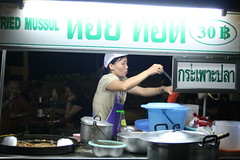
Bangkok will also make you fat if you enjoy it to the fullest; luckily we only spent a few days here... How can you even resist eating all day long in this paradise of street food stands, restaurants that cover all forms of Asian cuisine, cheap beer (isn’t that food as well?) and food-courts with an infinite number of choices? Shortly after finishing lunch in the “Food Avenue” at the 6th floor of the MBK shopping center we walked to the first floor and had some Chinese dim sum… Later we grabbed a few skewers of unidentified meat from a street grill. A short stop at Starbucks for coffee and a cake… beef-noodle soup as a late afternoon snack, pizza and pasta with wine for dinner. After a few beers at an open-air bar, we finish with a late-night gigantic bowl of chicken and noodles for one dollar from a street-side wok. And tomorrow we’ll do it all over again.
Posted from Siem Reap, Cambodia.

Click here to read more...

Wednesday, March 12, 2008

The dream islands

Angela, Jess and David in Ao Nang
Click photo to see slideshow
or here for all Railay pictures

The first night we stayed in Railay - a lush, rocky peninsula south of Krabi, with beautiful, isolated golden beaches - we partied hard in an open-air bar with Jess and David, two South Africans who happened to dine at the table near to ours earlier that evening. I yelled in their ears for a few hours, trying to make myself heard above the deafening music, until I lost my voice and could talk no more. That was the only time we had some late-night fun, because for the remaining days we spent in Thailand’s southern islands I kept nursing that sore throat and Angela had to fight a stomach bug she had most likely acquired while we were still in India. As a result, we had to drop our plan to go diving in Thailand (equalizing ear pressure is problematic when one has a cold) and we were lucky to be able to go on a snorkeling trip on our last day in Ao Nang, when we both felt finally healthy enough for an outing of the kind. Yes… Ko Phi Phi Leh Island (where The Beach was filmed, that dream-vacation adventure flick with Leo Di Caprio that made many a backpacker fantasize about never returning home) is as beautiful as they say, however I have no pictures of it. For once I chose to enjoy the water and the sun without worrying about the perfect camera angle and the direction of the light. We enjoyed the elements a little too much because we both got a bit burned despite then 45-SPF waterproof sun-block we used.

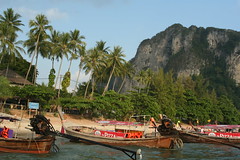
Long-tail boats in Ao Nang

The southern coast of Thailand seems to have become a favorite vacation destination for the Northern Europeans, mainly Swedes. You know that the powerful hordes of Euro-loaded Vikings have claimed the place as their own when the signs on shop doors are often written in a strange language that is obviously neither Thai nor English, when the restaurants advertise Swedish-Thai cuisine, and when the grocery stores sell you fresh tabloids from Stockholm. The Thai sellers of juicy and salacious news have smartened out and entered the digital age like the rest of us: the sheets on the display racks are not actual newspapers - which would have to be shipped from Sweden and would invariably be at least one-day stale by the time they got to the shelves - but stapled printouts of pdf files downloaded from the mighty internet. Whether the Thai merchants actually have a license for duplicating and selling those newspapers is doubtful; there is just too much pirated music for sale here to leave place for an honest, subscription-paying reseller. Every music CD you can imagine can be bought for 100 baht (that’s about $3) on the main tourist drag in Ao Nang, complete with color-printed album cover. Can you even imagine what Bangkok is like?

Thrilled about street food

Thai food, anyone? I would carefully avoid staying in a place like the Railay peninsula again – there is no in and out except by long-tail boat and you are stuck with a range of expensive restaurants that aren’t even living up to their prices and bring you insipid food to the table… and that in a country which lives to eat! After we moved to Ao Nang – a real town for a change – things got as bit better. I wouldn’t lose faith in the culinary delights of this country yet, but Thailand is certainly not India; hunger and the mere sight of a restaurant menu don’t make me drool with anticipation.

Yum! (from fotofeewa)

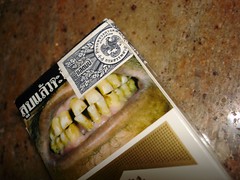
Still smoking? – There’s nothing like the cigarette packs for sale in Thailand to convince you to quit! Last I’ve checked cigarettes sold at home and in most of Central and South America still didn’t have any visual deterrent against smoking besides the mild warning of the surgeon general in minute print; Canadian and European packs had the big bold front prints with “smoking kills” and other horror stories that wouldn’t even send children scurrying away in fear… Well, Thai cigarette pack front panels have full-color pictures of cancerous lungs and lips, tracheal bypass tubes, and for the milder version, an man wearing wife-beaters (obviously a bad adult!) blowing the smoke in the face of a baby he holds in his arms… This explicit display of death may not instill the expected fear of smoking in too many potential consumers but it makes holding a pack of cigs in your hand somehow gross and certainly un-cool. Will this ever happen in the US? Maybe if one of those two lefties wins the next elections, who knows…

Published from Bangkok.

Click here to read more...

Sunday, March 9, 2008

Welcome to Thailand

We have been in Thailand since February 28, visiting the beautiful islands that dot the Andaman Sea coast in the Krabi province, but I had too many things left to say about India to bring myself to write something about our new hosts. Quite frankly, spending time in this tropical paradise is rather boring after having been in India, not to mention expensive. But at least Thailand has two things we have been missing for a while: cleanliness and Starbucks.

More stories coming soon!

Posted from Ao Nang, Krabi Province, Thailand.

Click here to read more...

Friday, March 7, 2008

Leaving Wonderland

Incredible India

After six rather exhausting weeks we left India on an early morning flight from Kolkata to Bangkok. As the purgatory of contradictory emotions faded behind the silver wing of the plane in the misty morning air I sat buckled in my cramped middle seat thinking that I should be able to say that I learned something from my Indian experience, preferably something deep, something about beauty, kindness or spirituality. Instead, all I could come up with was that I had become more skilled at bargaining for the last twenty rupees, that I learned how to dismiss the touts, hawkers, peddlers and beggars more gracefully, that I no longer got frustrated when people didn’t give me a straight answer and that I could live without toilet paper. A few months before in Egypt, the constant harassment that I had been subjected to had all but drained my reserves of social empathy, but India’s renewed assaults on my patience had in fact increased my tolerance to unwanted human contact and strengthened my ability to deal with ambiguity. In a country where nobody says “no” when they should, and every question is answered with a perplexing side-to-side wobble of the head that could mean anything, frustration and anger won’t get you too far...

Attack of the Alien rickshaws

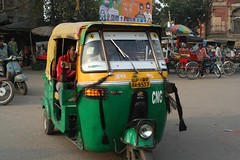
Every interaction is a bit of a struggle. Going to the place of your choice is a feat of endurance and patience when you have to depend on taxi or rickshaw drivers to take you there; they will try to divert you to the hotels where they get commission for your business (if you’re leaving the railway station or airport) and will ask you many times to reconsider your destination, ignoring each “no” that you blurt from the back seat, increasingly annoyed by their tenacity. Otherwise, if you’re just taking a ride through town you will be bombarded with offers to be taken to a great shop “only for looking”; if you’re hiring the driver for a city-tour the shopping trap may be disguised as “a quick visit to the cultural museum.” “No” is always the best policy; you may feel stupid for having to answer the same question again and again, but you can’t help admire their perseverance and optimism – the available rickshaws sitting idle far outnumber the tourists in search for a ride and the lucky winner of your business will understandably try a couple of tricks to add a few rupees to his evening meal.

Turistas, go home!

I don’t usually require a high level of comfort when I travel; I do well in noisy backpacker places, I’m ok sharing bathrooms, I’m fine enough if the sheets are clean and the toilet flushes, and I don't think hot water at the shower is necessary in a tropical climate. But in India, low-maintenance as I am, I had to lower my standards even more. Cheap rooms in budget hotels are rather gloomy; the crudely painted walls are stained with the flattened innards of dead mosquitoes, hard beds and lumpy, thin pillows are the norm, the weak pipes may catch you off guard with unexpected leaks and water jets when you turn on the wobbly and often slimy faucets; the drain may often be a simple plastic tube spilling its guts over your feet. You’ll pray that the floor is well surfaced and all the water flows toward the drain, but that’s not always the case and your bathroom will end up with a permanent puddle in one corner. There aren’t any bath tubs, shower cages or curtains; taking a shower means flooding the whole bathroom; you’ll wash the floors, the walls and the toilet as well, and if you don’t pay attention you’ll soak the toilet paper – but only if you brought some with you; generally it’s not provided since Indians do not use it.

India welcomes you... noisily

Hotel rooms have switches outside by the doors, which control the power to the plugs and light bulbs inside. Since the doors all have padlocks the hotel staff knows when you are not in your room and always turns the power off if you happened to leave it on. Forget about charging your camera batteries while you are out for dinner. Power cuts, accidental or planned, are frequent, making air-con rooms a less-desirable investment. Beer will be warm and hell only knows what happens with the frozen chicken during the blackout hours (just another reason to become vegetarian!) but internet will generally work – that’s what batteries are for, right?

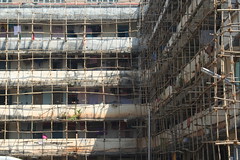
Indian scaffolding. Advanced technology.

I could continue to add details to the list of little strange things, uncomfortable situations and puzzling attitudes India assaulted us with, from the complicated telephone network made from a patchwork of incompatible operators to the strange but efficient train class and reservation system, from the unlicensed restaurants selling Kingfisher beer camouflaged in tea-pots and white cups, calling it “special tea” to the menu cards featuring fifty-four different types of masala dosa, from the irritating, dumb stares to the almost complete lack of display of public affection between Indian couples… but I’m afraid I would never finish and my blog will be forever stuck trying to cover India.

Shadows and gods

Beauty is everywhere, they say, you just have to know how look for it. And in India beauty is very well hidden behind rubble, trash and smog, a little less so in the countryside; it requires serious training and self-discipline to uncover. Nevertheless, a lot of travelers seem to be successful and find here whatever they were looking for; they leave elated and promise to return, undeterred by all the cow shit, the public pissing and shitting, the diarrhea, the hassle and the filthy toilets. For every tourist who finds his or her blissful karma in India there must be at least two or three who leave in tears, angry, sick and disappointed, and vow never to return before they show the finger to the airport departure hall one last time. I do not belong to either of those extreme categories; I had my share of disgust and anger but I was lucky enough to find peace and beauty when I least expected it; I cursed and rolled my eyes in frustration but I also smiled and went with the flow. I surrendered to India’s ebb and tide of sensations; I merely poked a finger at the magic mirror that opens into Wonderland. I will be back someday, armed with nothing but patience and an open mind.

Posted from Ao Nang, Krabi Province, Thailand.

Click here to read more...

Tuesday, March 4, 2008

The rest of India

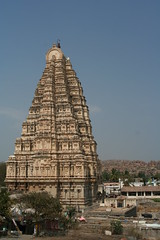
After Mumbai we moved fast through our remaining Indian destinations: a tour of the Hindu and Buddhist caves at Ellora and Ajanta near Aurangabad, a quick visit to the magnificent Taj Mahal in Agra, and a brief stopover between two night trains in Varanasi, the sacred city of the Hindus.

The Sacred Caves

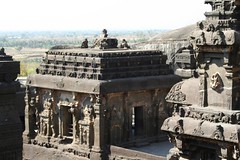
The Kailasa temple at Ellora
Click photo to see slideshow
or here for all Holy Caves pictures

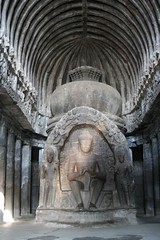
When I first saw the incredible caves carved in the mountainside on Elephanta Island, my first thought was “What the hell were they thinking?” But touching as it was, that visit didn’t prepare me for the sight of the incredible Kailasa temple, the crown jewel of the Ellora archaeological site near Aurangabad – a magnificent Hindu shrine cut out of the mountain rock, complete with gate, courtyard, standing sculptures and side-galleries; a true awe-inspiring sight worthy of being counted among the architectural wonders of the world.

Buddha
It’s the same all over the world: holy men and earthly rulers seem to have succumbed to the sin of pride time and time again, and have outdone themselves over the years building the houses of their gods in the most formidable and difficult ways imaginable in their times. The ones paying for this unrestrained holy ambition ended up being the thousands of workers who broke their backs digging and carrying the rubble.

While in Aurangabad, we had also planned to visit the equally-famous Buddhist caves of Ajanta, but in good tradition we woke up late and lost the little steam that we had left in our engines as soon as we walked out of our hotel in the excruciating afternoon heat…


Agra

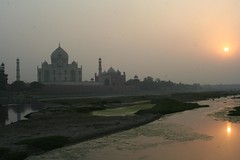
Sunset over the Yamuna river
Click photo to see slideshow
or here for all Agra pictures

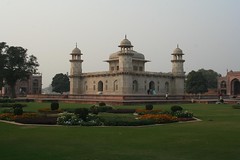
Taj Mahal entrance - Indian national: 10 rupees, foreigner: 1 million rupees… It’s not quite as high a number in reality, but the admission prices at national parks, museums and historic monuments are blown out of proportion for foreigners, and the Taj Mahal tops it all. Foreigners are charged more because they can afford to pay, and they do, but being told in the face “now’s the time when we take your money” is an experience I cannot ignore blissfully in a land where I am constantly asked to pay outrageous prices for every kind of goods and service. I’d be happier if I knew that the money went towards conservation and maintenance but I have a slight suspicion that given the precarious and derelict state of many historical landmarks, the dough will rather end up fattening some politicians and their wives…

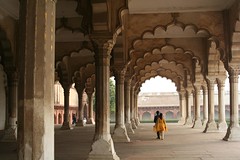
Palace inside the Agra Fort

It’s quite the irony that many of the masterpieces of Islamic architecture left by the Mughal Empire are located in the most god-forsaken, ugly, foul-smelling, nondescript city in the whole subcontinent. Agra is not only a place that’s impossible to enjoy on a visit - which may be an excusable deficiency, compensated by its abundance of famous monuments - it also has bad and uninspired food, and that is an unforgivable sin.

The "Baby Taj" - perfect symmetry

Don’t believe what the books say about the Taj Mahal changing colors at dusk and dawn with the setting or rising sun; it’s just a legend, deceiving many early risers and hopeful photographers - the famous marble monument to undying love is gray-whitish from morning till evening. The story of changing colors could be true only if Agra weren’t as polluted as it was when we visited - the sky was opaque and milky with smog all day; the thick, hazy air reduced visibility to no more than a mile ahead; the light was dull and discouraging for the many amateur photographers storming the gates at 6AM. Besides, my camera battery died shortly after sunrise. And then the spare decided to do the same…

Conclusion: do not stay overnight in Agra; you can visit the Taj Mahal, the fort and the other monuments during a day-trip from nearby Delhi.

Varanasi

Shedding bad Karma
Click photo to see slideshow
or here for all Varanasi pictures

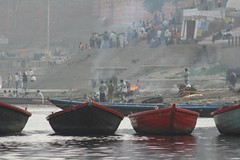
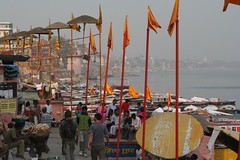
There’s probably no other city in India that symbolizes Hindu spirituality at its fullest as much as Varanasi, the ancient holy site on the banks of the Ganges. Along the river ghats devotees bathe with fervor to free themselves of sins and bad karma, dipping in the murky sacred water, undeterred by the sewers which pour the filth of the city in the river, the ubiquitous cow shit, the floating garbage and the general poor sanitary conditions. Spirituality and religious devotion can obviously live apart from and unhindered by the modern western concerns about health, noxious bacteria and the microbiological purity of water.

The burning ghats

Varanasi is also the temporary home to a large community of westerners, most of them sporting long dreadlocks and wearing clothes flaunting the “Om” sign in a variety of sizes and colors, meant to set them apart from the mass of regular tourists who are just “passing through”. They are the spiritual junkies in search for the ultimate redemption of the soul, and India is the supermarket where enlightenment and inner peace can be acquired and paid for in the currency of your choice: cash if you prefer the easy, chemical way, or hours of void-seeking meditation, passionate prayer to your favorite god, or selfless submission to a guru’s ashram rules. On the train from Agra to Varanasi we met an Australian guy who has been living in Varanasi with his wife and young son for the last two years. He was nice, helpful, with a wide congenial smile and talked casually; the only time I detected a slight tinge of smugness in his attitude was when he said, “You know, we’re big into this spiritual thing…” Like he belonged to the club of the selected few…

Life along the river ghats

The average conversations between westerners, which we could occasionally overhear in restaurants located in the labyrinth of narrow alleys behind the Ghats, were more along the lines of “duuuude, I cannot even begin telling you how fantastic India is… it’s so aaaawesome! I can’t describe how spiritual I feel here, I don’t ever want to leave!” Uhm, yea, ok… can I have a puff of that spirituality please?

Posted from Railay, Thailand - and I still have things left to say about India...

Click here to read more...