Run the equator

Sunday, March 9, 2008

Welcome to Thailand

We have been in Thailand since February 28, visiting the beautiful islands that dot the Andaman Sea coast in the Krabi province, but I had too many things left to say about India to bring myself to write something about our new hosts. Quite frankly, spending time in this tropical paradise is rather boring after having been in India, not to mention expensive. But at least Thailand has two things we have been missing for a while: cleanliness and Starbucks.

More stories coming soon!

Posted from Ao Nang, Krabi Province, Thailand.

Click here to read more...

Friday, March 7, 2008

Leaving Wonderland

Incredible India

After six rather exhausting weeks we left India on an early morning flight from Kolkata to Bangkok. As the purgatory of contradictory emotions faded behind the silver wing of the plane in the misty morning air I sat buckled in my cramped middle seat thinking that I should be able to say that I learned something from my Indian experience, preferably something deep, something about beauty, kindness or spirituality. Instead, all I could come up with was that I had become more skilled at bargaining for the last twenty rupees, that I learned how to dismiss the touts, hawkers, peddlers and beggars more gracefully, that I no longer got frustrated when people didn’t give me a straight answer and that I could live without toilet paper. A few months before in Egypt, the constant harassment that I had been subjected to had all but drained my reserves of social empathy, but India’s renewed assaults on my patience had in fact increased my tolerance to unwanted human contact and strengthened my ability to deal with ambiguity. In a country where nobody says “no” when they should, and every question is answered with a perplexing side-to-side wobble of the head that could mean anything, frustration and anger won’t get you too far...

Attack of the Alien rickshaws

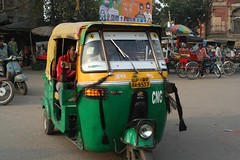
Every interaction is a bit of a struggle. Going to the place of your choice is a feat of endurance and patience when you have to depend on taxi or rickshaw drivers to take you there; they will try to divert you to the hotels where they get commission for your business (if you’re leaving the railway station or airport) and will ask you many times to reconsider your destination, ignoring each “no” that you blurt from the back seat, increasingly annoyed by their tenacity. Otherwise, if you’re just taking a ride through town you will be bombarded with offers to be taken to a great shop “only for looking”; if you’re hiring the driver for a city-tour the shopping trap may be disguised as “a quick visit to the cultural museum.” “No” is always the best policy; you may feel stupid for having to answer the same question again and again, but you can’t help admire their perseverance and optimism – the available rickshaws sitting idle far outnumber the tourists in search for a ride and the lucky winner of your business will understandably try a couple of tricks to add a few rupees to his evening meal.

Turistas, go home!

I don’t usually require a high level of comfort when I travel; I do well in noisy backpacker places, I’m ok sharing bathrooms, I’m fine enough if the sheets are clean and the toilet flushes, and I don't think hot water at the shower is necessary in a tropical climate. But in India, low-maintenance as I am, I had to lower my standards even more. Cheap rooms in budget hotels are rather gloomy; the crudely painted walls are stained with the flattened innards of dead mosquitoes, hard beds and lumpy, thin pillows are the norm, the weak pipes may catch you off guard with unexpected leaks and water jets when you turn on the wobbly and often slimy faucets; the drain may often be a simple plastic tube spilling its guts over your feet. You’ll pray that the floor is well surfaced and all the water flows toward the drain, but that’s not always the case and your bathroom will end up with a permanent puddle in one corner. There aren’t any bath tubs, shower cages or curtains; taking a shower means flooding the whole bathroom; you’ll wash the floors, the walls and the toilet as well, and if you don’t pay attention you’ll soak the toilet paper – but only if you brought some with you; generally it’s not provided since Indians do not use it.

India welcomes you... noisily

Hotel rooms have switches outside by the doors, which control the power to the plugs and light bulbs inside. Since the doors all have padlocks the hotel staff knows when you are not in your room and always turns the power off if you happened to leave it on. Forget about charging your camera batteries while you are out for dinner. Power cuts, accidental or planned, are frequent, making air-con rooms a less-desirable investment. Beer will be warm and hell only knows what happens with the frozen chicken during the blackout hours (just another reason to become vegetarian!) but internet will generally work – that’s what batteries are for, right?

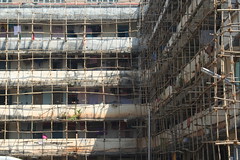
Indian scaffolding. Advanced technology.

I could continue to add details to the list of little strange things, uncomfortable situations and puzzling attitudes India assaulted us with, from the complicated telephone network made from a patchwork of incompatible operators to the strange but efficient train class and reservation system, from the unlicensed restaurants selling Kingfisher beer camouflaged in tea-pots and white cups, calling it “special tea” to the menu cards featuring fifty-four different types of masala dosa, from the irritating, dumb stares to the almost complete lack of display of public affection between Indian couples… but I’m afraid I would never finish and my blog will be forever stuck trying to cover India.

Shadows and gods

Beauty is everywhere, they say, you just have to know how look for it. And in India beauty is very well hidden behind rubble, trash and smog, a little less so in the countryside; it requires serious training and self-discipline to uncover. Nevertheless, a lot of travelers seem to be successful and find here whatever they were looking for; they leave elated and promise to return, undeterred by all the cow shit, the public pissing and shitting, the diarrhea, the hassle and the filthy toilets. For every tourist who finds his or her blissful karma in India there must be at least two or three who leave in tears, angry, sick and disappointed, and vow never to return before they show the finger to the airport departure hall one last time. I do not belong to either of those extreme categories; I had my share of disgust and anger but I was lucky enough to find peace and beauty when I least expected it; I cursed and rolled my eyes in frustration but I also smiled and went with the flow. I surrendered to India’s ebb and tide of sensations; I merely poked a finger at the magic mirror that opens into Wonderland. I will be back someday, armed with nothing but patience and an open mind.

Posted from Ao Nang, Krabi Province, Thailand.

Click here to read more...

Tuesday, March 4, 2008

The rest of India

After Mumbai we moved fast through our remaining Indian destinations: a tour of the Hindu and Buddhist caves at Ellora and Ajanta near Aurangabad, a quick visit to the magnificent Taj Mahal in Agra, and a brief stopover between two night trains in Varanasi, the sacred city of the Hindus.

The Sacred Caves

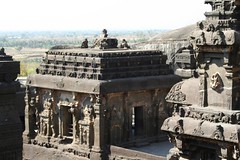
The Kailasa temple at Ellora
Click photo to see slideshow
or here for all Holy Caves pictures

When I first saw the incredible caves carved in the mountainside on Elephanta Island, my first thought was “What the hell were they thinking?” But touching as it was, that visit didn’t prepare me for the sight of the incredible Kailasa temple, the crown jewel of the Ellora archaeological site near Aurangabad – a magnificent Hindu shrine cut out of the mountain rock, complete with gate, courtyard, standing sculptures and side-galleries; a true awe-inspiring sight worthy of being counted among the architectural wonders of the world.

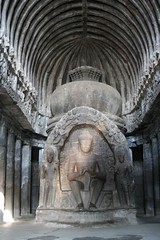
Buddha
It’s the same all over the world: holy men and earthly rulers seem to have succumbed to the sin of pride time and time again, and have outdone themselves over the years building the houses of their gods in the most formidable and difficult ways imaginable in their times. The ones paying for this unrestrained holy ambition ended up being the thousands of workers who broke their backs digging and carrying the rubble.

While in Aurangabad, we had also planned to visit the equally-famous Buddhist caves of Ajanta, but in good tradition we woke up late and lost the little steam that we had left in our engines as soon as we walked out of our hotel in the excruciating afternoon heat…


Agra

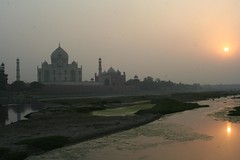
Sunset over the Yamuna river
Click photo to see slideshow
or here for all Agra pictures

Taj Mahal entrance - Indian national: 10 rupees, foreigner: 1 million rupees… It’s not quite as high a number in reality, but the admission prices at national parks, museums and historic monuments are blown out of proportion for foreigners, and the Taj Mahal tops it all. Foreigners are charged more because they can afford to pay, and they do, but being told in the face “now’s the time when we take your money” is an experience I cannot ignore blissfully in a land where I am constantly asked to pay outrageous prices for every kind of goods and service. I’d be happier if I knew that the money went towards conservation and maintenance but I have a slight suspicion that given the precarious and derelict state of many historical landmarks, the dough will rather end up fattening some politicians and their wives…

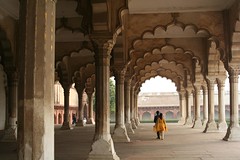
Palace inside the Agra Fort

It’s quite the irony that many of the masterpieces of Islamic architecture left by the Mughal Empire are located in the most god-forsaken, ugly, foul-smelling, nondescript city in the whole subcontinent. Agra is not only a place that’s impossible to enjoy on a visit - which may be an excusable deficiency, compensated by its abundance of famous monuments - it also has bad and uninspired food, and that is an unforgivable sin.

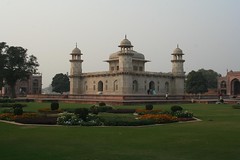
The "Baby Taj" - perfect symmetry

Don’t believe what the books say about the Taj Mahal changing colors at dusk and dawn with the setting or rising sun; it’s just a legend, deceiving many early risers and hopeful photographers - the famous marble monument to undying love is gray-whitish from morning till evening. The story of changing colors could be true only if Agra weren’t as polluted as it was when we visited - the sky was opaque and milky with smog all day; the thick, hazy air reduced visibility to no more than a mile ahead; the light was dull and discouraging for the many amateur photographers storming the gates at 6AM. Besides, my camera battery died shortly after sunrise. And then the spare decided to do the same…

Conclusion: do not stay overnight in Agra; you can visit the Taj Mahal, the fort and the other monuments during a day-trip from nearby Delhi.

Varanasi

Shedding bad Karma
Click photo to see slideshow
or here for all Varanasi pictures

There’s probably no other city in India that symbolizes Hindu spirituality at its fullest as much as Varanasi, the ancient holy site on the banks of the Ganges. Along the river ghats devotees bathe with fervor to free themselves of sins and bad karma, dipping in the murky sacred water, undeterred by the sewers which pour the filth of the city in the river, the ubiquitous cow shit, the floating garbage and the general poor sanitary conditions. Spirituality and religious devotion can obviously live apart from and unhindered by the modern western concerns about health, noxious bacteria and the microbiological purity of water.

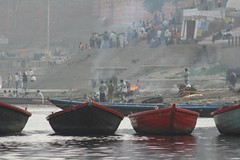
The burning ghats

Varanasi is also the temporary home to a large community of westerners, most of them sporting long dreadlocks and wearing clothes flaunting the “Om” sign in a variety of sizes and colors, meant to set them apart from the mass of regular tourists who are just “passing through”. They are the spiritual junkies in search for the ultimate redemption of the soul, and India is the supermarket where enlightenment and inner peace can be acquired and paid for in the currency of your choice: cash if you prefer the easy, chemical way, or hours of void-seeking meditation, passionate prayer to your favorite god, or selfless submission to a guru’s ashram rules. On the train from Agra to Varanasi we met an Australian guy who has been living in Varanasi with his wife and young son for the last two years. He was nice, helpful, with a wide congenial smile and talked casually; the only time I detected a slight tinge of smugness in his attitude was when he said, “You know, we’re big into this spiritual thing…” Like he belonged to the club of the selected few…

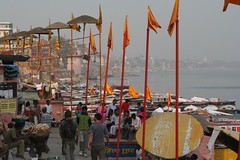
Life along the river ghats

The average conversations between westerners, which we could occasionally overhear in restaurants located in the labyrinth of narrow alleys behind the Ghats, were more along the lines of “duuuude, I cannot even begin telling you how fantastic India is… it’s so aaaawesome! I can’t describe how spiritual I feel here, I don’t ever want to leave!” Uhm, yea, ok… can I have a puff of that spirituality please?

Posted from Railay, Thailand - and I still have things left to say about India...

Click here to read more...

Friday, February 29, 2008

Mumbai

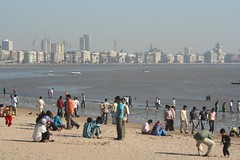
An afternoon at Chowpatty beach
Click photo to see slideshow
or here for all Mumbai pictures

  “Charras, mister? Some Hash?” a man shouts at me from the sidewalk. He’s busy relieving himself between two cars parked at the curb, but his head is turned to me. Obviously the bodily function he is attending to is not enough to prevent him from noticing western tourists crossing the neighborhood.
  “No thanks,” I reply and I keep walking in the middle of the street; the sidewalk is too crowded. It’s getting dark and the street is busy with pestering hawkers, people cooking in their mobile kitchens, dirty kids dressed in tattered clothes, gawking tourists and Indian men sitting idle, grabbing their crotches.
  “You look like you need some!” the pusher tries one more time, and goes back to his not-quite-so-private duty seeing that I ignore him.

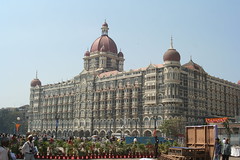
The Taj Mahal hotel
No, this is not where we stayed

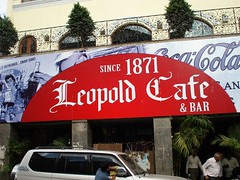
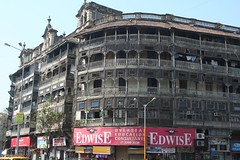
I can’t leave my room at the Volga II hotel, right next door to Leopold’s Cafe, without being propositioned for hashish multiple times by the shady characters that hang around this major tourist spot in the heart of the Colaba district. Leopold’s is so popular with tourists that it draws crowds at the front doors, hopeful travelers clutching their Lonely Planet India bibles, waiting for a table to become free. The food is mediocre but the bar on the upper floor is nice. In “Shantaram”, the last novel I finished before arriving in Bombay, key parts of the action take place in this establishment, and many spirited, intelligent conversations unfold here during a round of drinks. My imagination has built up a different place; in it, Leopold’s was a large hall reached from the street by a short flight of stairs; there were dim lights hanging from low ceilings, a long brass bar counter in the back, massive wooden furniture and wall decorations and enough space for people to cruise between the tables without brushing against each other.

Leopold's Cafe
The real thing had none of that: Leopold’s bland-looking dining room is located at street-level; it’s rather small and well-lit, it has no bar counter, the ceilings are tall, the furniture is standard and the tables are so close to each other you can hardly move your chair without bumping into the back-rest of the person sitting behind you. Through a door in the back a flight of stairs leads to the upper-level air-conditioned bar, a narrow L-shaped room whose matted-glass windows overlook the dining hall. It’s not too exciting a place, and I certainly wouldn’t make the stuff of legend out of it. But it may have looked different in the 80’s when the story in “Shantaram” is happening. And we all know that the eighties were awesome.


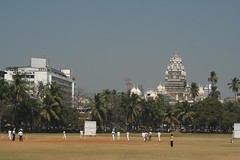
Cricket players on the Oval Maidan

Of all Indian towns that I had already visited (and those that I would be visiting in the following weeks) Mumbai is the only one I liked. It is a place where you can even enjoy a walk through town; the filth is kept under control, the green areas are groomed and the sidewalks do not border on open sewers. Old tree-lined streets hide aging, moldy colonial mansions and boutique hotels; neighborhoods of high-rises and shopping malls stretch for miles in areas free of squatters and beggars; majestic, ornate Raj-era buildings like the Court of Justice, the CST railway station and the Prince of Wales museum define the centre and attract camera clicks; neat air-conditioned coffee-shops offer true divine espresso, wireless internet access and remind a bit of Starbucks; the maidans (centrally-located open, grassy areas where people play cricket or just hang out) are taken care of and occasionally re-planted with fresh grass.

The Kashmiri Hotel
It must have seen better times
There’s a certain kind of third-world cleanliness to Mumbai that makes tourists feel urban for the first (and only) time in India, an air of prosperity that is well-reflected in hotel and real-estate prices. According to a newspaper article, rental prices for similar apartments are as high in Mumbai as in New York, taking a toll on the finances of many expats working for multinational companies or Indians returning from overseas who hope to match the comfort of their previous homes. I had to dig deeper in my finances too – our shabby room with shared bathroom in the Colaba district was 700 Rupees – a hole in the wall that would cost no more than 200 in any other town in India. Compared to Goa, the same beer comes at double the price in Mumbai; good coffee is more expensive than at home, but who can live without it anyway? At least the taxi drivers use the meter – if you insist.


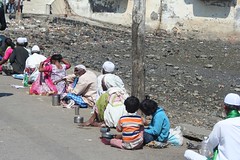
Beggars on the Haji Ali causeway

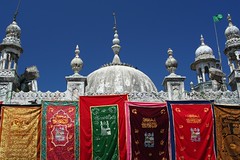
Yet Bombay, if you look outside of the tourist areas, the old neighborhoods built by British or the flashy suburbs of the nouveau riche, has the same poverty like the rest of India and nowhere is it better seen than in the flood of beggars that line the causeway leading to the Haji Ali mosque – an icon of Bombay, located on a tiny piece of land that becomes an island at high tide. One side of the narrow concrete path is crammed with a motley assortment of humanity with missing body parts: maimed children looking sheepish, raising scrawny open hands in a plea for coins or pulling weakly at your clothes, as if to remind you of your feelings of western social guilt, groups of half-naked men exhibiting varied deformities, chanting a repetitive mantra to attract attention, old disfigured women covered in ragged dirty saris looking haggard, too exhausted to beg or move, decrepit elderly men collapsed on the pavement in the torrid sun, sleeping, or maybe dead – no one cares; if they’re still there at high-tide when the others have gone away, the sea will take care of their remains.

Haji Ali Dargah

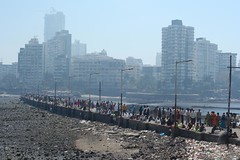
The other side of the five-hundred-yard-long causeway is the domain of the trinket sellers; here unthinkable loads of crap can be yours for a few rupees: key rings dangling small pink images of Ganesh the elephant god, plain brass or woven bangles, water pistols, decorated sea shells, combs, buttons and toothbrushes, electric toy-cars and crying Virgin Mary icons. The tiffin boys bring lunches to the peddlers (they must be making some money after all) winding their way through the crowd, balancing trays of five, six plates of rice and curry; yet I didn’t see any wealth resulting from the improbable sales being redistributed across the lane to the beggars who seemed to wait in vain for charity from visitors and pilgrims. But on our way back from the mosque we stumbled upon the most unexpected of sights - a man dressed in white pants and shirt walked the whole length of the causeway bowing in front of every beggar, putting a coin in their hands or dropping it in their tin cans. For a long time I followed this good Muslim giving his share of zakat to the poor of Mumbai until I lost sight of him. Once again it occurred to me that India is a land of unequalled contradictions, of cruel indifference and heartfelt compassion, the best and worst of everything.

The road to redemption

Close to the Haji Ali causeway a few children were playing cricket on a concrete strip surrounded by fields of plastic garbage left behind by the low tide. From giant billboards advertising pale skin cream and glittering gold jewels, gorgeous young women were sending their frozen seductive smiles at the swarming, indifferent crowd. Distant skyscrapers shrouded in smog were flickering with Indian pride while a goat was rummaging unabashed through the mountains of refuse at my feet, in search for food. I looked back one last time toward the white, gleaming mosque and I made a place for this unforgettable city in my heart.

Posted from Railay, Thailand - gotta catch up fast!

Click here to read more...

Monday, February 25, 2008

I still have sand in my shoes

Beach cabins in Agonda
Click photo to see slideshow
or here for all Goa pictures

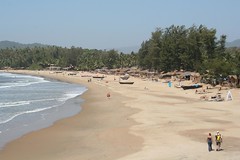
Tell me one thing: when you go for a vacation in a resort or village by the seaside do you feel that you are missing something if you stay in a place that is located more than two steps away from the beach? Do you feel deprived of an essential experience if you can’t see green waves breaking into white froth or calm ripples caressing the golden sand from the window of your room? Well, apparently a lot of people feel like that. How else can I explain the mile-long spread of straw-huts tucked between the sandy strip and the first palm trees that mark the outline of Palolem beach in Goa?

Patnem beach

The reality is less idyllic – with few exceptions these huts are not really directly facing the beach but behind one of the many seafront restaurants; they usually come in pairs: no beach bar without its allotment of huts in the back. This way the tourists are caught in a double trap: as soon as they get out of bed they start spending money for breakfast. Before bedtime, one more drink… We looked at the huts as well; I hate to have sand in my bedroom but I was willing to try this sort of accommodation for the sake of being able to say “I stayed on the beach in Goa.” Sadly all the huts we saw had one thing in common – they looked cheap and unwelcoming; they were absolute trash. The buildings were on three-foot-tall stilts; they were all made of thin plywood or wood-fiber netting; most had no real windows just blinds. Each step taken inside was making the whole scaffolding shake; some floors even had weak spots that gave way under your foot, disasters waiting to happen. The interior varied in size but the same simple square layout was repeated ad infinitum – a bed covered by a mosquito net, a ceiling fan and sometimes a night stand. The more fortunate had a second, smaller room in the back that served as bathroom; the plumbing looked fragile, and in more than one case it consisted of an open tube that drained on the sand below the hut.

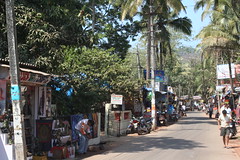
Palolem main street

I can’t imagine how those monstrosities could incite anyone to stay inside one second more than they had to. Some of them were not without a certain charm though – there were wicker chairs outside by the doors, a hammock here and there, colorful canvas awnings hanging above the porches. The prices were shameless – anywhere from 300 Rs (about $8) to 1000 Rs ($26) per night. With some bargaining you could get a hut with a shared “bathroom” (located in a different shack) for 250 Rs. I didn’t really see any significant differences between the higher and lower end of the price spectrum – the rooms looked all similar, they only varied in size. There was only one such hut-village that had the privilege of being called “upscale” – the sturdy, good-looking cabins were made of wood and brick and had real windows; there were grass lawns in front of them and the sandy alleys were paved with stone slates. They were charging 3500 Rs a night and were booked solid, so we couldn’t even see one on the inside. I still can’t see the fascination of going to a hippie beach camp in India only to pay the equivalent of $100 a night…

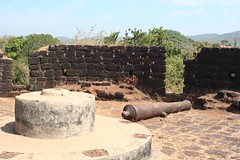
Cabo de Rama
Remains of the portuguese fort

Since there was nothing acceptable between the two extremes, our fleeting dream of staying on the beach evaporated during the half-hour I spent looking at over a dozen “hotels”. We walked back to the main street and got a room on the upper floor of a two-storey building hidden between the palm trees. For 400 Rs we had a quiet, large room with cable TV, a bathroom with tiled floor and walls (a rarity in India where crude concrete masonry is the norm) and - almost unheard of - hot water at the shower! The beach huts were forgotten on the spot. And I don’t like roasting in the sun anyway...
Posted from Varanasi, home to a large community of dread-locked westerners in search for the ultimate spirituality.

Click here to read more...
Friday, February 22, 2008

An Indian itinerary

Street celebrations in Kochi
Click photo to see slideshow
or here for other South India pictures

If you look at my recent posts you may get the impression that we are having a horrible time in India. Indeed, many first-time travelers to the subcontinent are so disgusted with their experience they vow never to return. It’s not hard to understand why: in the streets, age-old garbage is piled up in every corner and you run the risk of stepping in open sewers; the budget hotel rooms are, with few exceptions, dingy, unwelcoming and claustrophobic; the traffic is mad; the bathrooms are filthy and toilet paper is a luxury. On top of all that, there are a billion Indians surrounding you: at any time, a few hundreds of millions of them seem to be busy clearing their throats noisily and spitting passionately. From the moment you enter the country you are accompanied by that distinctive half-retch, half-gurgle crescendo followed shortly by the unmistakable suction and release of projectile launch. People are, in general, not very friendly, and even less helpful; anywhere outside restaurants you are asked to pay prices ten times higher than what locals pay; the staring at and harassment of foreigners (mister, madam, what country, give me money, give me a pen, etc…) is constant and the display of poverty is crushing and heartbreaking.

Spiritual enlightenment?

Yet, once you master the arts of looking without seeing and bargaining without losing your cool, once you realize the necessity to adjust your pampered, western-minded habits in order to survive your vacation without going crazy, once you finally surrender to India you will see your surroundings and yourself in a completely different light. I can’t say that you will attain spiritual enlightenment and return home a better and purified being, but you will, at least, have a good time. India is not one of those countries that win you over from the moment you get off the plane. You don’t fall in love with it at first sight. No, India has to grow on you; it gets to you slowly, unseen. Once you move past the foul moment when you want to get out of the country by the first available plane, you are in danger of starting to like it. Then you will soon realize that no matter how you plan your trip, you still have too little time to experience all that India can offer.

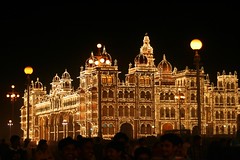
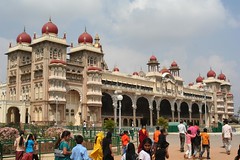
Mysore palace - a true jewel

We have worked our way north from the southern tip of India through Kerala, Tamil Nadu, Karnataka and Goa all the way to Mumbai. With the exception of Goa, where we got lazy under the palm trees for a full eight days, eating real Italian pizzas and drinking cheap beer, we stayed no more than three or four days in one place. Most times we wished we had left earlier; occasionally we regretted not staying longer. Cities like Trivandrum, Cochin and Chennai weren’t much to look at; they are certainly interesting and unusual but could hardly be called nice, let alone beautiful. Beach towns like Varkala in Kerala, Palolem in Goa and Mamallapuram in Tamil Nadu were pretty, low-key and relatively stress-free, but they’re not really representative of India – aren’t all tropical beach villages more or less alike? The highlands of the Western Ghats in Kerala were a good place to run away from the mad crowds and the smothering heat of the coastal plain but the nights were freezing and we weren’t prepared for the cold anymore, nor wishing it. On top of that, the promised wildlife experience doesn’t stand up to your expectations once you’ve been in Africa. Mysore, the famous one-time capital of the prosperous kingdom with the same name, had a pleasant highland climate, hot and dry during the day and cool at night; it boasts the beautiful palace of the bygone maharajas but little else to hold us for more than a couple of days.

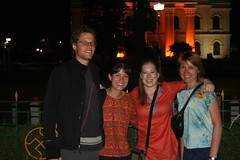
Hangin' out

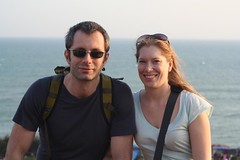
We haven’t made many friends – you can’t really, when you move that fast – but we have met Mark and Sarah from Zurich on a local bus to Kumily and we’ve run into them again in Ernakulam, Mysore and finally in Goa, sometimes by chance, sometimes by plan. They, like us, are travelling around the world for a year but their trip is only at the beginning. Beside a few dinners, lunches and visits to museums, their company has materialized into a memorable night of drinking in Ernakulam, when Mark and I visited the raunchiest dimly-lit bars in town, where only men go for a drink, and ended up having beers on the beach surrounded by a handful of boys who kept asking us in a respectful tone (“sir”) to give them money so they can bring us more beer, drugs or women. We didn’t give, they didn’t bring…

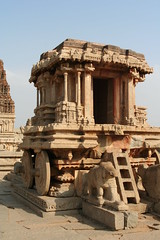
Stone chariot
Click photo to see slideshow
or here for the Hampi set

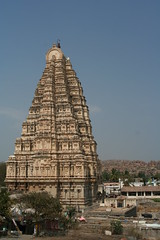
The one destination I wished we had allowed ourselves more time to enjoy was Hampi. This hamlet in the hills of Northern Karnataka is home of the most awe-inspiring landscape of ruins I have ever seen: the glorious ancient imperial capital of Vijayanagara. Acres of rocky land sprinkled with piles of giant boulders lie in front of the intrepid explored, brave enough to defy the terrifying afternoon sun. At every turn of the dusty winding path, behind each sun-burned hillside hides a revered Hindu temple, mysterious, cold and cavernous, or the four shabby stone walls of the ghost of a crumbling workshop. Some are barely worth a close look – structures the size of a small house, rough stone slabs put together hastily and held in place by the indifference of time; others beckon you like irresistible temptations – they are vast, artistically elaborate, well preserved temple complexes, looming large ahead of your camera lens, imposing, beautiful.

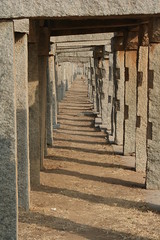
Follow the light
You cannot help but marvel at the perfection and complexity of the stone work. You walk around along the high walls in the square courtyards, you carefully tread into the dark innermost chambers - the now-empty shrines where the sacred statues of Vishnu and other deities of the Hindu pantheon used to be guarded and worshipped, you walk up and down the stairs polished by millennia of stomping feet, and when all has been photographed from all angles you can still revel in the music of the singing pillars – the tall stalks of stone which adorn the columns that support the temple ceiling and produce musical notes when knocked.


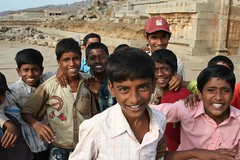
Picture of me please!!!

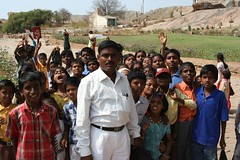
And when you decide to take a break from so much stone beauty, you will likely end up having to deal with a riotous mob of Indian school children on a field trip who want to have their picture taken with the conspicuous and obviously expensive SLR camera hanging around your neck. They call you “sir” and “madam” and above all, want to know which country you are from. It doesn’t matter what your answer is, they will giggle and run and shove one another in front of you and ask you again and again… Later, when you are tired of wandering through the hills like an overexcited archaeology student you can sit down and spend some time watching the boulders. It’s peaceful.

Published from Agra, in the shadow of the Taj Mahal

Click here to read more...
Thursday, February 21, 2008

Contact info

Email: fritz_in_seattle AT yahoo DOT com
IM: stugren AT hotmail DOT com

Don't add me to your IM contacts if you don't know me already; I will reject any such requests.

Click here to read more...

Thursday, February 14, 2008

Devoured by corporate greed

Does anybody remember Traveler's Cheques? You know, these pieces of paper that resemble money and can be redeemed for cash almost anywhere (at least anywhere where tourists go?) A while ago, when ATMs weren't the norm around the world, traveler's cheques were the preferred currency of people who visited foreign lands. And why? Because unlike cash the cheques, if stolen or lost, can be replaced, allegedly with no hassle, within 24 hours after the loss is reported to the issuer. And I said "allegedly" for good reasons...

Before leaving in April 2007 we bought $1500 in American Express cheques from my bank. We have only cashed a couple of hundreds in Honduras; the rest have been stored in various purses, bags and moneybelts for most of our trip. We saw that we still had them in December and early January. Then, as we got to Turkey we noticed that cheques worth $600 had disappeared. The trouble was... we didn't exactly remember where the cheques were when they were lost. They may have been in the checked-in bag that went missing in Bucharest on the way to Turkey and from which our backgammon and chess games were taken, or they may have disappeared earlier, stolen or simply lost...

Owing to the vagaries of our fast-paced trip we didn't report the loss until we got to India. I spent hours on the phone with the customer service, and the calls were not free - although AmEx boasts a toll-free number in India, phones in this country don't work like any westerner would expect: toll-free numbers cannot be called from most phones or are not actually free (but I should leave the story of the Indian phone systems for later...) I faxed them what they wanted, including copies of our passports, visas and cheque purchase slips, and in the end I landed as a file with a claim-number on the desk of a certain Eva in the Sydney international claims office. I had to tell her the whole story again and on top of that I had to avoid the little traps she was planting in the conversation like "you said you work for IBM?" - "No I never said that, I used to work for Microsoft". I said the same things over and over again a few times although the truth was clear and simple: we didn't exactly know when the cheques were lost, and in which of our bag they were. We had some ideas, but we did not know for sure...

The claim got denied almost immediately because my story was deemed "inconsistent". When I demanded an explanation from Eva, she kept beating the same old horse of the "inconsistent story", and stopped short of accusing me of fraud (although she was implying it). She told me she cannot talk about the details of this claim with me and hung up. My only way of appealing the decision is in writing.

Upon hearing all this I made a little more research in the matter of how American Express deals with claims of lost traveler's cheques. Shockingly, it appears that many claims are denied - people who forget their wallets in taxis, people who have stuff stolen from their hotel rooms, people robbed at gun-point, people who provide police reports, all categories of cases get denied for two all-covering reasons: inconsistent stories and negligence. The lucky ones who finally get their money seem to do so only after an initial denial. The amex buying agreement says that you have to treat your cheques as cash. What that means is not clear, but it gives them a way to get out of their obligation to provide a refund in case of loss - they can always allege that you have not been careful with your belongings, therefore they do not need to pay.

The bottom line is this - I don't have the cheques amymore, they have not been cahsed - or claimed by a money changer - and American Express has my money. Is this me or it seems like I have been defrauded by Big Business, with my own complicity?

The public wave of discontent with American Express' business practicess has even its own Web site, AmexSux.com. There are just too many horror stories on their message boards to mention...

After this mishap, I have to add American Express to my own personal black list of evil American corporations who treat their customers like dirt, right there with Verizon, Citibank, Comcast and a handful of insurance companies. I will close all my accounts, forget all my passwords, keep all my cash in 100 dollar-bills sewn into my clothes and move to a coconut-tree-covered tropical island... But not before I flood American Express with letters of intent to sue and I get my money back!

Posted from Palolem beach, Goa - India

Click here to read more...

Sunday, February 10, 2008

More random tourist bits about India

Here comes another installment of bullet points containing my condensed thoughts about India. Warning: some of these opinions may seem sweeping, unfair generalizations, but as it often happens when you’re a tourist and you see only the superficial side of things, the truth doesn’t matter as much as the way you perceive it.

    A monumental pile of trash
  • India is the dirtiest place I’ve ever seen (for a while I thought it was Egypt). It’s difficult for anybody coming from the Western world to understand why mere meters away from the spotlessly clean temple or palace where you are requested to take off your shoes in order to enter, lies a mountain of garbage in open air. It’s the curse of all developing countries where social conscience is not yet mature, that people consider their home limited to the four walls of their houses (which, no doubt, they keep clean) and look at the street and the outdoors as a sort of no-man’s land where all sorts of refuse can be dumped with impunity. We’ve always thrown the trash in the alley behind the house. Why should we change our ways now?
  • Kanyakumari beach
  • Indian cities are unlike those I’ve seen in other parts of the world. In my opinion, they can’t even be called cities: they’re reminiscent of some sort of chaotic, crumbling beehives; they appear like gigantic villages built hastily of a patchwork of construction materials, without a plan and without points of reference. There is no city center in the traditional sense, no visible street signs, few direction indicators and almost no traffic signs. If there is any street numbering system it is - by and large - not used. In fact, most hotels and restaurants listed in our travel guides are identified only by the street they are located on. Taxi drivers are supposed to just “know” where your destination is, and they often do in small towns, but in larger cities you have to help once they get to the street you gave them. How does mail ever get delivered here?
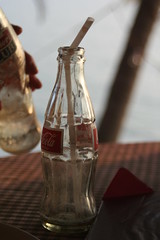
  • Pepsi or Coca-Cola?
  • Communication – so far our experience on this trip has been that people who deal often with tourists – taxi drivers, hotel attendants and restaurant waiters – are the ones most likely to speak and understand English, whereas people working in government-related jobs – train station, post office, museums – would often just shrug or shower you with a long answer in their language, although their own common sense must tell them that you can’t understand. In India the situation is somehow the opposite, and unfortunately, the bunch that seems the least accustomed to English are the waiters. I haven’t been in any high-class restaurant, but on the average waiters here are quite unhelpful. Questions about the menu are mostly met with blank stares, and special orders are a recipe for disaster (Angela’s request for a separate side-serving of milk for her coffee has often produced unexpected, sometimes hilarious results). There's nothing wrong with not speaking English - although, at least in theory, it's supposed to be one of the official languages of India - but nobody will tell you that they didn’t understand what you said; they will just assume. More than once we have asked “do you have Pepsi or Coca-Cola?” only to be told “Yes, one Pepsi, and one Coca-Cola?”
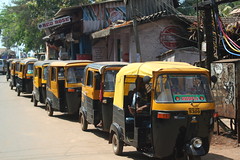
  • Too many rickshaws!
  • One category of service providers is particularly loathed by tourists – the rickshaw drivers. The ubiquitous little, open and noisy three-wheelers can fit the two of us and our backpacks; throughout India we have preferred them to the more expensive taxis. However the drivers are an awful lot; they always ask an outrageous price for the fare, and more often than not, when you land in their territory loaded with your backpack, not knowing where to go, they see you at their mercy and refuse to negotiate. On our arrival at the Canacona train station in Goa, there were five of us tourists who got off the train. We would have taken three rickshaws to Palolem beach, but none of the drivers was willing to slash their over-inflated price by more than 10 rupees. We decided to boycott them en masse, and walked the 2 kilometers that separated the station from the village. The drivers, rather than cutting the price, drove past us back to town in their empty vehicles.
  • Indians seem to be unusually fond of their government – being associated with the government in some way appears to give a measure of stability, confidence and trustworthiness to any enterprise. The hotel’s number of stars is awarded by the government; this bank is an enterprise of the government of India; that bus station is certified by the government; here’s the government tourist office; we’re visiting the government incense factory.... Hell! even the packs of stray dogs living on the beach must be sanctioned by the government. I made that last one up, of course. On the average Indians, like any other people, must think that politics is dirty and all politicians are corrupt, but the truth is that the government, as an abstract nationally-representative entity, has a very conspicuous presence in public life.
  • More communication please? – It’s commonplace truth that you don’t really know a country until you know its people. But that’s not always easy. Indians of all ages are quick to ask tourists where they are from, but their opening lines rarely lead to any meaningful conversation and you will inevitably end up trying to avoid any contact. The touts will speak to you in order to lure you into their sales talk, but many people on the street, especially younger men, would address you with the same exhausting, irritating question: “What country?” To avoid future unwanted attention (guaranteed to happen if I tell them I am from America), I follow the advice of a friend of mine who spent some time in India on her own trip around the world, and I say that I am from Guatemala. They have never heard of Guatemala and they don’t know what to do with the answer (Romania would have done just as well, but Guatemala sounds more forbidding). They turn their heads around and move on without even saying good-bye. I used this answer a lot since I came to India, and you know what? Not one of those “friendly” locals has ever asked me where Guatemala is.
Posted from Palolem beach, Goa - India

Click here to read more...

Saturday, February 9, 2008

Teletext

We are now in Palolem, a beach village in Goa, on the coast of the Arabian Sea. It's not an isolated end-of-the-world hippie hangout, but it's small enough to make an acceptable choice for those who hate the streaming crowds of western tourists that have invaded the northern beaches by busloads, and large enough to provide a decent variety of restaurants, bars and reliable internet cafes. More details on the way!

Click here to read more...