To all of you, regular or accidental readers of my blog, have a Merry Christmas! Or Happy Holidays, if you would prefer me to be politically correct. Anyway, drink a lot, be happy and don't drive!
F&A
Tuesday, December 25, 2007
By the way...


4 days in Bucharest

This one is from Wikimedia commons
My aunt was nice and allowed us to stay with her in Bucharest for a few days. We had planned to see the city (or at least that I would show the city - which I have seen many times before - to Angela), take some pictures, and perhaps see a museum or two. But things didn't go as we intended. Laziness and constant bad weather slowed our engines; instead of taking to the streets, we locked ourselves up in my aunt's apartment, read old National Geographics and watched TV (which in Romania, with the exception of cartoons, is mostly in original language, so Angela didn't have a problem understanding).
Despite our general lack of interest for street hiking and the huge distance (my aunt lives all the way at the edge of town) we managed to get downtown twice. Once we spent most of our time looking for a toilet - luckily McDonald's is well represented in Romania - the other time, one evening, together with my aunt, we tried to get into a restaurant for dinner and kept running from place to place across downtown, since all our choices were booked for company Christmas parties. Either way, there wasn't much to enjoy in downtown Bucharest during those drab winter days. The streets and sidewalks were covered in a thin layer of liquid mud - the eternal curse of all Romanian towns during the rainy season - there were works on all the main streets and unmarked man-made pot-holes adorned many corners. In summer, the same streets are swept with dust by the hot wind of the southern plains, but at least the trees are green and the skies are blue; you can walk and feel good and stop in a beer-garden and then walk some more. But not in this wailing December weather; no, the warmth and shelter of the apartment were much more appealing than the cold boulevards...
Posted from Cluj-Napoca.Saturday, December 22, 2007
Taxi, taxi!
How do you know if you're getting ripped off by the taxi drivers waiting on the curbside in front of the airport? There's no easy answer, but it pays to check a few things ahead if you want to keep your money in your wallet. Depending on country, local laws, and the strength of the cab-driver unions, you may or may not be in danger of getting suckered into paying a little fortune for the ride downtown. Sometimes you don't have a choice - the airports are usually far out of town, and if no other transportation alternatives are available (it's too late at night or you have too many bags to drag yourself to the bus) you are stuck with whatever price the taxi drivers ask, and you have very little room for negotiation. Egypt is one example: there the taxi drivers working at the airports are like a crime syndicate (and the others are just petty thieves). You think you can just walk over to the next one and negotiate a better price?
I knew there were going to be taxi sharks at the Baneasa airport in Bucharest. Romanian cities have always had two kinds of cabs: the radio-dispatched cars affiliated to companies, practicing decent, uniform prices, and the "independents" who prey on unsuspecting out-of-towners and foreigners, and who would often charge ten times as much as the others. The trouble is, there's no easy way to distinguish between them. I didn't know what to expect: I hadn't visited Romania in over three years, money and prices had changed, and I had never taken a taxi from the airport, preferring the bus or having friends waiting for me. But we were going to land at 2AM; there was no night bus, and I had no friends left in this town anymore. Before the flight, a quick online check on Lonely Planet's ThornTree travel forum clarified things a bit - at least all taxis had to have the prices per kilometer posted in clear view on the passenger's door.
With that information in mind I stepped out of the Bucharest-Baneasa airport at 2AM, in a pouring, cold December rain. An army of yellow taxis with black checkered stripes was waiting at the curb, but none of the people who had just gotten off the same plane was rushing to them. Most were calling others on their cell phones, waiting for friends to pick them up. "Taxi mister, taxi?" I kept hearing as I cruised the sidewalk avoiding the puddles, trying to read the prices printed on the passenger doors of the cars. A few times, when the touts became insistent, I told them to sod off in Romanian. They were all independents, charging around 8 RON per kilometer (1 USD is about 2.4 RON), and some even had the audacity to try to convince me that it was a good price. If I believed them, for the 20km ride to my aunt's neighborhood at the other end of town, I would end up paying 60 to 70 dollars.
Patience paid off - Bucharest-Baneasa is one of those lucky few airports located in town and not out in the fields; thus new cabs arrived often, even at that early hour of the morning. Before long, I was able to stop a company cab as it pulled in front of the arrivals gate. 1.79 RON/km said the door sticker. Don't let this one get away! During the ride I talked with the driver about the "independents" and their shameless prices. The company-affiliated drivers often have clashes with the sharks about rates and territory control but in the end it's a free country and everybody is allowed to scam whomever they want. As long as the prices are in clear view (even if they are in minute print), it's OK to take the money away from the poor suckers who come to visit our beautiful country...
Not from us though, you won't. We've been to too many places. I may be wearing glasses, but I can still tell the crooks from the honest!
Written in Cluj-Napoca.Monday, December 17, 2007
Barcelona
“It’s 370 Euros for the seven nights, pay ahead,” the guy at the front desk said. Making a quick calculation, I frowned: “We don’t have so much money with us now, but in any case, when we talked on the phone you told me it was 50 Euros per night, so this doesn’t add up.”
“No, I told you 60 Euros.”
“You already charged my credit card for one night, 50 Euros as we agreed.”
“No that was just the deposit; the rate is 60 per night, due on arrival for the whole stay.”
“Now… you may have said something about the payment being due on arrival, I think I remember, but it was definitely 50, not 60 Euros per night.”
“Ok, ok, 50, I don’t care, I don’t want to argue. You can pay the whole sum tomorrow morning.”
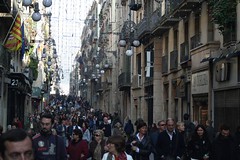
Click on pic to see slideshow
or here for the Barcelona set
This conversation was taking place at 1AM on our arrival night in Barcelona, at the hotel Rembrandt, first in Spanish, and then in English - the guy nursing the reception desk at that late hour was an Indian and all three of us naturally drifted to the one language we could best use for arguing. He was clearly trying to scam us (later on I found the notes that I took when I booked the room on the phone, and I had indeed written down 50 Euros for the room with bathroom, and 40 for the one without) but we didn’t agree on what to do: Angela became angry and wanted to leave immediately; I advocated sleeping there for the night and leaving the next morning - it was already late, and finding another suitable hotel at that hour wouldn’t have been easy. To minimize the damage, I made sure the guy agreed he wouldn’t ask for more money besides the 50 Euros he had already charged us, and I made clear we won’t pay before the next day, if we decided to stay. I had my way, but not without getting an earful from Angela, how “this isn’t right and we should have left immediately!” I appreciate people with principles, but only when it doesn’t imply dragging a 50-pound backpack about the streets in the middle of the night… The moral of the story: don’t go to Hostal Rembrandt in Barcelona, even if it’s featured in Lonely Planet. It’s a dump, and you can find better budget hotels at a cheaper price. Besides, you’ll avoid an argument with your wife, if things go sour…
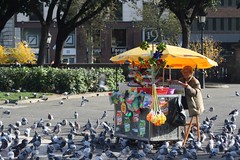
All ended up fine the next day as I found the Hotel Principal (two stars), which, for being more pricey (80 Euros), offered all the comforts longed for by backpackers who had been sleeping for too long in cheap hostels: a large, tall room, a view to the street, a gigantic bed, TV (although all channels except for EuroNews were in Spanish), hard-wood floors, silent air conditioning that actually responded to the temperature controls, and a bathroom with futuristic showers that required a PhD to operate. It even had “original artist paintings” (touted as such in the hotel brochure) on the walls – maybe that’s why the extra Euros… the starving artists who had sold their hearts to the necessary evil of corporate design had to make a buck too. No breakfast was included, but internet access, including wireless, was. I didn’t balk when I heard the price; I got it as soon as I saw the room.
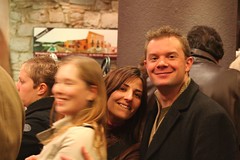
at a basque eatery
For us, after so many cities visited, Barcelona was just another big town, albeit one that you can fall in love with in the long run. It isn’t a flashy poser like Rome but a city that slowly grows on you because of its very distinct personality. Food… well, food just kept getting better. You can’t be wrong if you had three shots at the culinary art of a country (Madrid, Seville and Barcelona) and things have steadily gone from better to best. Spanish cuisine is now definitely the sweetest of my love-affairs with food.
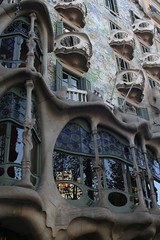
What do you do if you’re a tourist in Barcelona? You climb up the escalators to Montjuic and snap some uninspired panoramic photos of the city below; then you sit and relax watching the kids at play in the beautiful terraced gardens that take you back into town; you walk the never-ending blocks with “shaved” corners in the Eixample and get lost in the all-identical streets; you visit the Picasso museum and stare in amazement at the many cubist studies of Velasquez’s Las Meninas; you stroll up and down the Ramblas and enjoy the crazy crowd of passersby, gawkers and living statues; you cannot miss a visit to the Sagrada Familia temple, and if you still have energy and taste for architecture you go and see the Gaudi houses – Casa Battló and La Pedrera - at least from the outside, if you’re not willing to spend the money to get in. And these are just some highlights…
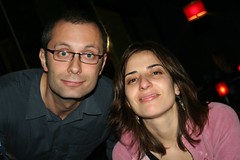
In Barcelona I met Robert again, my Dutch friend that I knew from my Nuremberg days in 1999/2000, when we both worked for Lucent Technologies, and with whom I somehow kept in touch all those years. He brought along the lovely, wry, sharp-tongued Eva, his Spanish long-distance girlfriend. We went out every night, taking the city by storm, one restaurant at a time and got home mostly drunk, defeated by the abundance of exquisite tapas and good wines. To them I owe the fact that I finally saw the “Bodies” exhibition. If they hadn’t insisted that they wanted to go and that Eva could get cheap tickets using some “points” from previous purchases, I wouldn’t have bothered dishing out the 17 Euros for the regular entrance. This exhibition had been on display for months at the convention center, two blocks down the street from our apartment in Seattle, and I didn’t bother visiting – not because of the price (in any case it was lower than in Europe) but because of lack of interest. I had to admit it was in fact very interesting and instructive, although by the time I got to the second room I had developed an uneasy feeling that didn’t leave me for the rest of the time I spent inside: I became aware of my heart pumping blood, my bowels working and my nerves trying to transmit vital impulses… If you are still smoking, the Bodies exhibition will make you want to quit… at least until you get out and light one up…
Published from Cluj-Napoca, Romania.Saturday, December 15, 2007
Break
Recently I had neither enough time nor many opportunities to update the blog. Stories from Barcelona and Romania (may be) coming soon.
Wednesday, December 5, 2007
Nothing to do in Seville

Click on pic to see slideshow
or here for the Seville set
As we boarded the train at the Atocha station in Madrid, we had lots of plans for the four or five days we were going to spend in Andalucía. But when we arrived in Seville everything fizzled out little by little and we ended up spending the next three days eating well and shopping. First, the plan to travel to Granada petered out; taking the train or bus there and then getting from Granada to Barcelona was going to cost too much. So when we found a cheap plane ticket from Seville straight to Barcelona we decided to forgo the Alhambra. In Seville itself, we weren’t very proficient with the monuments – we walked the beautiful narrow streets of the old town but didn’t enter one single tourist attraction. The magnificent Seville cathedral was charging 7.50 Euros entrance fee, and I decided that the Catholic Church would not have my money anymore. If I can’t get into a church for free, I won’t get in at all (although I was going to break this oath later at the Sagrada Familia in Barcelona).
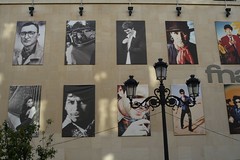
We compensated our lack of cultural interest by spending a lot of time at fnac (the French cultural and consumer-electronics megastore) and El Corte Ingles, buying the iPod Nano G3, and downloading a lot of music. And no doubt, we redeemed ourselves by sampling the elaborate culinary offerings of the many tapas bars spread all over town. “Es arte, no es cocina,” the waitress at Los Coloniales told us as she brought a delicious plate of sandwiches with foie gras and cold roasted pork cuts, topped with fried quail eggs. I licked my fingers knowing I have reached a new apex of culinary delight. And things were going to get even better…
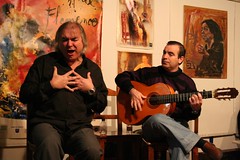
In defense of “traditional” cultural activities, on one of the evenings we went to see a free flamenco show in a bar. The singer and the guitar player put up a good, passionate performance, but it was not amplified, and a lot of the people in the back of the bar kept on talking. The background noise bothered the singer (who had to keep reminding the audience not to speak and not to smoke) and annoyed the people who were actually there for the music. Of course, if the show hadn’t been for free, this wouldn’t have happened.
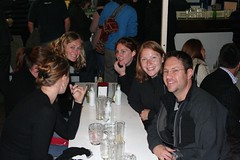
The Oasis Backpacker Hostel, our lodgment in Seville, is a nice renovated building with a great location, but, as it happens with most places which have “backpackers” in their name, it is very loud. The hotel is built around a small inner courtyard which has been covered with a glass roof, and now holds the reception, a few couches and the computers with free internet access. As such, this makeshift “lodge” is a very popular place, and it’s no surprise that the rooms at the higher floors get a share of the conversations that happen downstairs. The hostel seemed to be full with nothing but young American students, most of them girls; the word “like” kept popping up in their conversations - which were mainly about drinking or bad boyfriends - with an unprecedented frequency. But among all those aliens we meet Paul, an American traveling alone around the world not for one, but for two years (of which he has completed half). We spent some time with him exchanging travel ideas and blog tips (is there even one person traveling for a long time nowadays, who doesn’t keep a blog?). He has lots of stories and good pictures at http://pauls-paradigm2.blogspot.com.
At the end of the three days, we left Seville largely unexplored and headed for Barcelona hoping for good weather, more good food, and eager to meet my friend Robert whom I hadn’t seen in something like 5 years…
Written in BarcelonaThursday, November 29, 2007
Living la vida loca!
Forget falafel, forget tzatziki, forget pizza and pasta – in Spain we have reached culinary Nirvana. Tapas-hopping is a wonderful Spanish tradition that turns dinner (or lunch) into a bar-crawl. You eat a few olives here, some grilled prawns there, a portion of stuffed champignons here and some chorizo or roasted pig-ear in yet another place, all sprinkled with lots of your favorite wine or beer. Of course, these make just a very modest list; in reality, the variety of foods served at any tapas bar is enough to keep newcomers busy experimenting with strange or unfamiliar foods for weeks.
Click on pic to see slideshow
or here for the Madrid set
As in many European countries, you can still smoke in bars and restaurants in Spain, and cigarettes are available from numerous automated dispensers. The locals take ample advantage of this benefit and you’ll be hard-pressed to find even a restaurant that has a non-smoking section. But things are changing – a few popular places, mostly chain-style restaurants, have started to display very conspicuous non-smoking signs, and people seem not to mind the restriction and still flood these establishments. Where smoking is allowed (and that is almost everywhere), explicit signs say “Esta permitido fumar,” but the same signs also mention that smoking can be harmful and cause heart and lung disease. In my opinion it is just a question of time before Spanish smokers will be forced to take their cigarettes outside, like they are now in Italy.
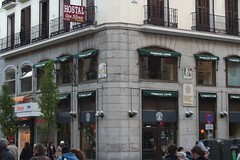
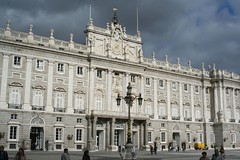
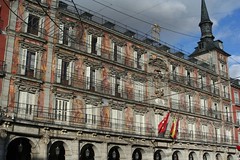
Madrid doesn’t have the intense and overwhelming beauty of Rome, but its charm is nevertheless undeniable, primarily because of the crazy, outgoing, fun way of life that Spaniards have adopted. The downtown streets are full of people every evening, bars (including those that serve food) stay open very late - they close just in time for the nightclubs (some still called “discos”) to open, and no Spaniard seems to be ever having dinner at home, despite the high prices (yes, we had a round of drinks in a bar where every alcoholic beverage on sale, except for the beer, was 14 Euros - have you ever tried a screwdriver for $20?). This propensity for social life and long-lasting parties comes as no surprise after the 36 years of hard repression by the Franco regime, when the country was in a permanent curfew. Indeed, as a bitter joke, bars and restaurants have kept on their walls the menacing warning signs of the dictatorship era: “Prohibido cantar y bailar” (singing and dancing prohibited) say those engraved plaques, screwed in the tiles above the heads of the cheering crowd. Never again, the jolly Madrileños seem to reply.
Despite this atmosphere of freedom and relaxation, Spain is well aware that it has been caught in the middle of a sinister war, the war on terror. I’m not sure whether this has happened before or in the aftermath of the Madrid train bombings, but Spain, like the US, has sacrificed some convenient freedoms for the greater (some may dispute the adjective) benefit of increased security. Larger railway stations, which in Europe have always been places where you can run to the platforms and hop on the train at the last minute, have become more like airports – the platforms are now fenced out from the waiting halls by sturdy, tall cast-iron railings, and access to the train happens through a scanner gate where, akin to the security checks at airports, all bags are x-rayed.
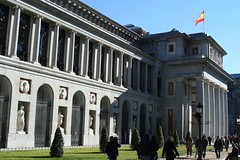
In other, more personal news, after all those museums full of statues and ancient mosaics and the archaeological sites we saw in Rome, switching our focus to “painting appreciation” has been a welcome change. Madrid has two of the most famous art museums in the world – the Prado, home to most of Goya’s and Velasquez’s works, where lines for tickets are permanently winding around the building during opening hours, and the Reyna Sofia, which boasts a fantastic collection of modern art, including the gripping Guernica (along with many other works by Picasso), a few rooms of Dali, and – in my uneducated opinion – too much of the over-appreciated Miro.
The city’s ferial atmosphere has cast its spell on us enough to convince even me to do some shopping. I bought a winter coat; my Marmot jacket can only help when winter temperatures are still bearable (like in Argentina or Greece), and besides, after 7 months of traveling it has accumulated dirt and food spots to the point that I have become ashamed to go into town wearing it. I was sad when we left Madrid; 5 days in this city had not been enough; we could have easily enjoyed a few more. But we were heading south for Seville and I could not resist the call of warmer weather…
Posted from Barcelona.Tuesday, November 27, 2007
Muzak! Muzak!
We have given in to Christmas-shopping temptation: we bought an iPod Nano in Seville!
Now Angela's up in the room downloading all her favorite songs fom iTunes on our laptop, while I have to wait in the lobby for one of the hostel's computers to become free... that is, when all those 20-year old American girls who were busy talking drama and boyfriends all night in the kitchen are done checking their Facebook and MySpace pages...
Saturday, November 24, 2007
Ciao Roma!
In November, temperatures in Rome are close to the freezing point; every other day the rain washes the streets while gusts of wind threaten to sweep the flimsy umbrella - which you just bought for 4 euro at the subway exit - out of your hand. Yet being in Rome will redeem the frightful weather and your uninspired decision to visit Italy in this ugly time of the year.

Click on pic to see slideshow
or here for the Rome set
There is something about Rome that puts it ahead of all other famous cities that I have seen. I tried to define that quality so I can understand the fascination better, but it still eludes a precise explanation. It has something to do with the incredible mix of history that permeates every stone and every street. It is certainly about the great food and red wine. And no doubt, the friendly and boisterous Romans are part of the mix that makes the city so special. But no great words or hard work are needed to sell Rome to visitors – even in the midst of this harsh winter, the city was full with tourists and the cheap hotels were booked solid.
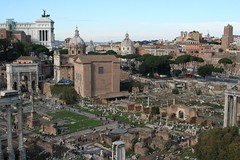
For us, the 5 days we spent in town were hardly enough: from taking a stroll through the ruins of the Roman forum after working out a bit while climbing the stairs to the upper levels of the Coliseum, to staying in line in the rain waiting to get into the Vatican museum, from shopping along the Via del Corso to having a cheap delicious dinner at an osteria in Trastevere, from visiting the Pantheon, the most striking example of surviving ancient Roman architecture, to cruising along the walls of the narrow streets around the Campo dei Fiori – there was no shortage of things to do and see in Rome. Prospective guide-book itineraries are entitled “Rome in 1 day” or “Rome in 2 days”, but in such short time you can only skim the surface of things and collect some unforgettable but superficial first impressions.
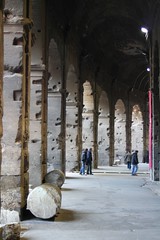
Rome is demanding, but easy to discover. The metro, while quite underdeveloped for a city this size, gets to a few essential spots, like the Termini railway station (best neighborhood for cheap hotels and easy access) the Coliseum and the Vatican. There are plenty of buses going where the metro won’t, and with a small map of the bus network you can easily figure out how to get between any two points in town for just one Euro. Taxis are not expensive if you stick to the area within the old city walls, where most places seen by tourists are anyway. Finally, walking across town is not such a bad deal - if you aren’t in a rush and the rain has stopped.
We left Rome again with a desire to return as soon as we can... If only for the fact that shortly after getting into the famous Vatican Museum and paying for the ticket, we were gently ushered out because the museum was closing early in winter… at 12:30pm, no kidding. I feel like I’ve been ripped off by the Catholic Church!
Posted from Madrid.Saturday, November 17, 2007
Tzatziki and house wine by the liter
Click on pic to see slideshow
or here to access the Nafplion set
“3.60 Euro for Tzatziki? No, it’s too expensive; let’s look at the next taverna down the street.” Over the last few days we have worked out a system to pick restaurants for lunch or dinner – the tzatziki (a typical Greek bread dip made with creamy sheep yogurt, cucumbers and garlic) has to be under 3€ and the house red wine under 4€ for ½ liter. We drink wine by the liter in Greece and always the “house” variety, which, unlike in the United States, is a decent choice in most restaurants. The rest of our lunches and dinners typically consist of Greek salads (cucumbers, tomatoes, onions, olives and feta cheese), mousaka, souvlaki, gyros, loukaniki or other Greek meat specialties, and the ubiquitous French fries that accompany every Greek dish. For breakfast, unless it’s the simple choice that some hotels offer, we always have a cup of delicious yoghurt topped with honey and walnuts. Like the real tzatziki, the traditional plain Greek yoghurt is made with sheep milk, which is creamier, more consistent, and probably contains significantly more calories than the cow milk variety. I have not searched the specialty “gourmet” stores in Seattle, but this kind of yoghurt is not available in the grocery stores at home. In fact, in the US, the large stores usually carry one single brand of plain, unsweetened, yoghurt, and it’s often inedible. But I’m sure there must be some American Greeks somewhere, who have found a way to bring the flavors of their old home to the new continent…
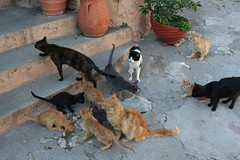
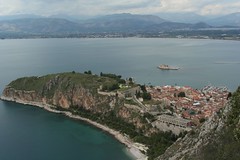
Arriving in quiet, cobbled, manicured Nafplion, after the three weeks spent in chaotic Egypt, was a bit like waking up gradually from a dream and figuring out that the world still made sense. Nobody was harassing me, trying to get my money; nobody was insisting that I go to their shop. I was driving a car and all the roads were clearly marked in Greek and Latin letters. There was no garbage lying in the ditch by the road. The streets were quiet - it was November, after all. Traveling in Greece at this time of the year can be very convenient: the off-season hotel discounts are very enticing; often you pay the half of the rate the same rooms go for in high season. You don’t even need to reserve anything in advance, since the supply exceeds the demand by far. The weather is generally good for hiking and sightseeing (not for tanning, mind you), albeit a bit erratic – you may have to deal with alternating days of rain showers and beautiful skies. But Greece is also a country that would sober up any tourist who has travelled extensively in the third world – prices are, well… European, and this reflects best in the rates charged for internet access – they average around 4€ (about 6$) for one hour. Ah, where is Bolivia…
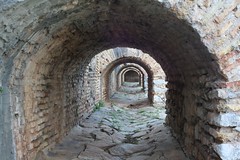
There was not much reason to go to any of the islands at this time of the year, so we stuck with the many historical attractions on the mainland. We picked up a rental car at the Athens airport and drove to Nafplion, a jewel of a sea-side town, with a pretty historical center of narrow streets, lined with tavernas and shops, dominated by the Palamidi fortress - a gigantic system of fortified walls built by the venetians on top of the hill overlooking the town, during one of the periods they ruled the place. Not far from Nafplion are the antique amphitheater at Epidavros (restored and used for festivals in summer) and the ruins of ancient Mycenae. With all good intentions, we tried to visit the city of mighty Agamemnon, but the new owners, the museum authority of Greece, were closing the place at 2:45pm in winter and we got there too late…
Click on pic to see slideshow
or here to access the Byzantine Towns set
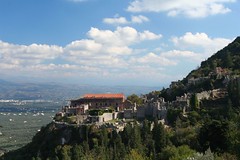
The byzantine hill towns of the southern Peloponnese, Mystras and Monemvasia, tell a different history lesson. Although they are mostly in ruins now (Monemvasia however, has a few beautiful restored streets where tourists can sleep and spend money), they live on in the spirit of countless movies with medieval setting. Every fictional town built in terraces on the slopes of a mountain, with narrow, cobbled streets winding through stone gates, with houses and defensive walls hanging above rocky ravines, with an imposing fortress on the top of the hill, overlooking the valley, is in fact made up from the blueprint of these byzantine towns. They are quite interesting to visit, even if just to wonder what it would have taken to keep a city like that functioning – the sewers, the water supply, the transportation, the social life. It must have been nice to live in a town where every single house had a view…
Click on pic to see slideshow
or here to access the Delphi set
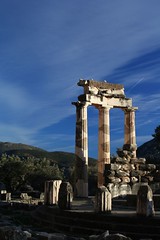
Back in antiquity and out of the Peloponnese, we stopped at Delphi to look for gods hidden among the scattered fallen column stones and the remnants of the once-glorious temples of Apollo and Athena. There were no gods, just tourists there – Delphi is nowadays the main day-trip destination of tour groups visiting Athens. But it was November and the invasion of tour buses was in minor key; even if the weather was beautiful, ideal for hiking up the slopes of Parnassus, there were so few other tourists around that I was able to take some pictures of the ruins without including people in them – such a feat would have been impossible in summer.
Click on pic to see slideshow
or here to access the Athens set
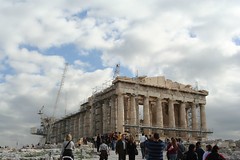
Finally, there was Athens – a big, dull, (and nowadays clean as well) city, where tourists get bored fast. The place is full of ancient history, but nevertheless, nobody falls in love with it. I didn’t either, but the food was good and the discovery of a Starbucks store in town made my stay sweeter. I went to the post office as well, but even if you count the fact that I went looking for it on the wrong street for a while (before realizing that it must have moved since the Lonely Planet book that I had was researched), the experience was nothing like the one in Egypt. Athens may not be glamorous or charming, but it has the incredible Acropolis, with its 25-century-old temples perched upon a craggy rock rising in the middle of the busy town, and that’s enough to keep you coming back. You have to stop here on your way to the islands anyway…
Published from Rome.
Subscribe to:
Posts (Atom)